Voiding
What is it
Voiding in rail engineering means a loss of effective support beneath the sleeper or ballast layer, creating a gap or poorly supported zone where the track does not bear properly onto the ballast or formation. In practice, a void may be invisible when no train is present, but under axle load the unsupported sleeper or rail may deflect excessively.
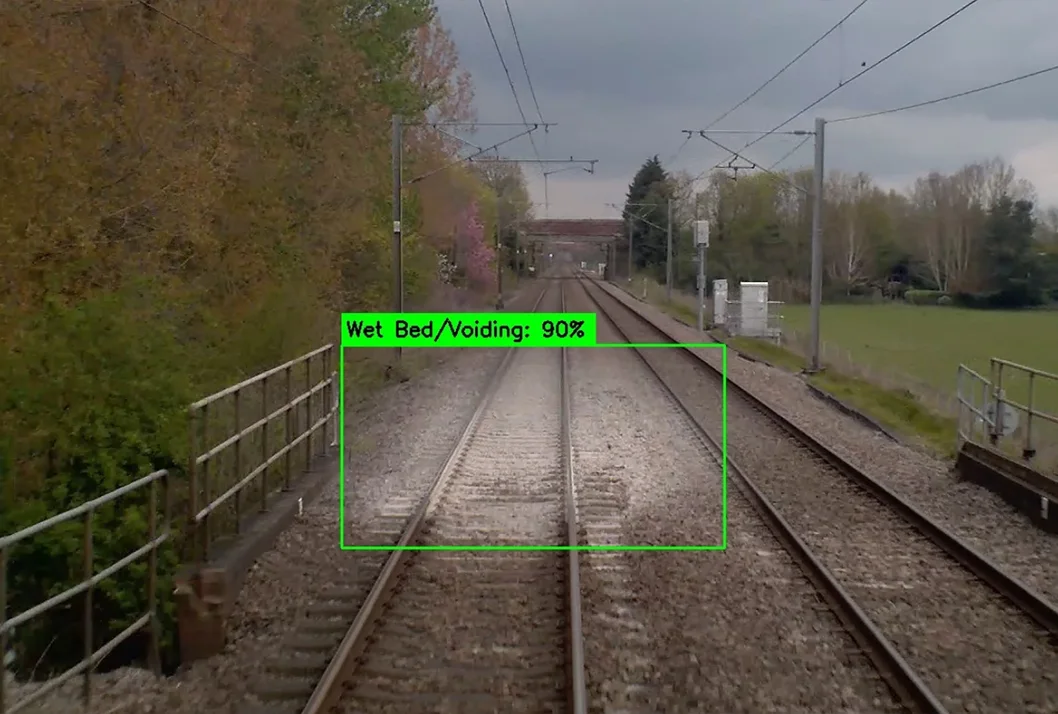
Voiding is automatically captured and detected by AIVR.
Why it matters
Voiding matters because the affected sleeper is no longer able to share wheel loads as intended, so adjacent sleepers and ballast are overloaded and track movement increases. This can accelerate geometry deterioration, worsen ride quality, damage fastenings and ballast, and create a feedback effect in which repeated dynamic loading enlarges the void and spreads the defect longitudinally (i.e. along the track).
Where and when it’s used
Engineers have long encountered voiding as part of wider trackbed and support problems, especially in wet beds, contaminated ballast, transition zones and switches and crossings (S&C), where loading is less uniform and support conditions can change rapidly.
How it develops
Voiding usually develops when ballast settles, rearranges or becomes fouled, or when the underlying formation loses stiffness because of water ingress, weak soil or repeated dynamic loading. The result is a local cavity or loss of contact under part of the sleeper or trackbed, so the track initially ‘hangs’ over the unsupported area until a train load forces it down. That impact-like reloading increases deflection, damages the ballast structure, and transfers greater force to adjacent supports, which can make the void larger and the local stiffness variation more severe over time. If left uncorrected, voiding can progress into more serious track defects such as cracked/ineffective sleepers, broken joints and broken rails, as well as track geometry exceedances above actionable limits.
Monitoring and maintaining
Traditionally, voiding has been identified through visual signs, track geometry deterioration, rough ride reports and site inspection, but it can be difficult to confirm because the defect is load-dependent and may not be obvious at rest.
One Big Circle (OBC) has worked with Network Rail to detect wet beds and voiding using AIVR forward-facing video and machine learning object detection, allowing maintenance teams to locate and assess likely sites remotely without putting boots on ballast. More broadly, OBC’s suite of AIVR products now combines video, line-scanning and geometry data, helping engineers relate suspected voiding to support loss, drainage condition and track movement so that tamping, ballast treatment, drainage repair or deeper trackbed intervention can be targeted more effectively.