Low Ballast
What is it
Low ballast refers to locations where the ballast profile has reduced below its intended level, leaving insufficient stone around and beneath sleepers to provide full support, confinement and drainage. In practice this often appears as exposed ballast shoulders, shallow crib ballast (i.e. between sleepers), or thin ballast depth under the sleeper compared with design standards or adjacent track.
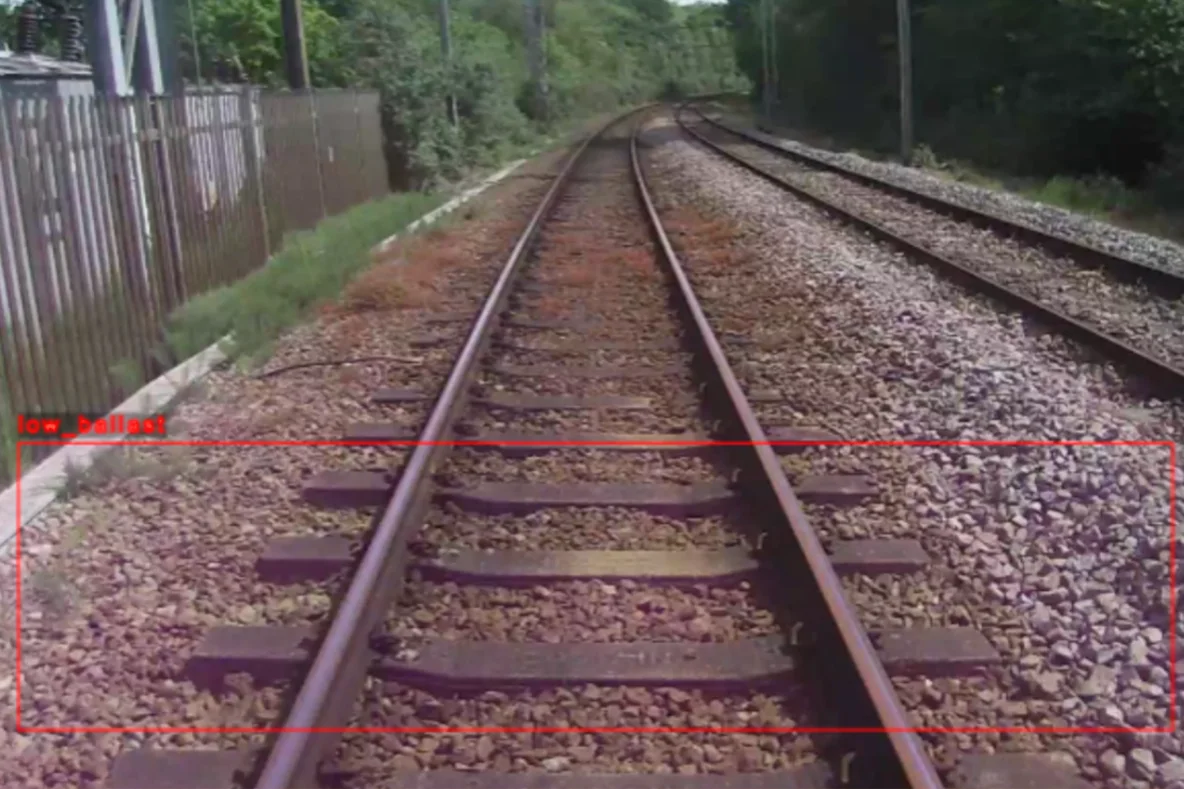
Remote identification of low ballast on the AIVR Platform – supporting proactive maintenance planning without trackside exposure.
Why it matters
Because ballast distributes wheel loads, stabilises the track and provides drainage, a loss of ballast compromises vertical support, lateral restraint and water management. Persistent low ballast can accelerate track geometry deterioration, increase dynamic loading on the formation, contribute to wet beds or voiding, and drive up maintenance interventions such as tamping, stoneblowing and ballast renewal. Deficient ballast levels can cause track buckles in high temperatures, where the ballast provides insufficient lateral support to the track.
Where and when
Low ballast typically develops at higher risk locations, for example embankments, where ballast can be lost by slipping down earthworks. High tonnage can also degrade ballast condition, leading to increased settlement. Managing low ballast at ‘track discontinuities’ is particularly important in mitigating the risk of track buckles. Discontinuities are those parts of the track system that interrupt otherwise continuous wheel–rail support or contact; for example, transitions onto structures such as bridges or slab track; turnouts (points and crossings); level crossings; even tight curves.] It also appears where drainage is poor or formation conditions are weak, for example in cuttings, at subgrade soft spots, or where track maintenance has disturbed the ballast formation.
How it develops
Mechanisms leading to low ballast include gradual ballast degradation and loss of angularity, which causes plastic deformation and settlement of the ballast skeleton; as the layer densifies and breaks down, sleeper support level drops. Additional causes include ballast flight and stone loss (where stones are shaken loose and flung off the track by the air displacement caused by the onrushing train), historic under‑ballasting, contamination and fouling that reduce effective depth; and differential settlement over soft formations or at transitions, all of which can leave sleepers under-supported and shoulders low.
Monitoring and maintaining
Historically, low ballast was mainly identified through lineside inspections and Basic Visual Inspections, requiring staff to walk the line and record sites manually. Today, systems such as One Big Circle’s AIVR Ballast Condition Monitoring capture forward-facing video from in-service trains and apply in-house machine learning classifier models to automatically detect low ballast, scoring severity and flagging locations in map-linked reports for engineers. This enables remote, repeatable condition monitoring, supports targeted tamping, stoneblowing or ballast renewal, and helps reduce ‘boots on ballast’ while improving safety and efficiency on routes such as Network Rail’s Eastern Region, where low ballast and wet beds are being monitored as part of collaborative trials.