Low Ballast
What is it
Voiding in rail engineering means a loss of effective support beneath the sleeper or ballast layer, creating a gap or poorly supported zone where the track does not bear properly onto the ballast or formation. In practice, a void may be invisible when no train is present, but under axle load the unsupported sleeper or rail may deflect excessively.
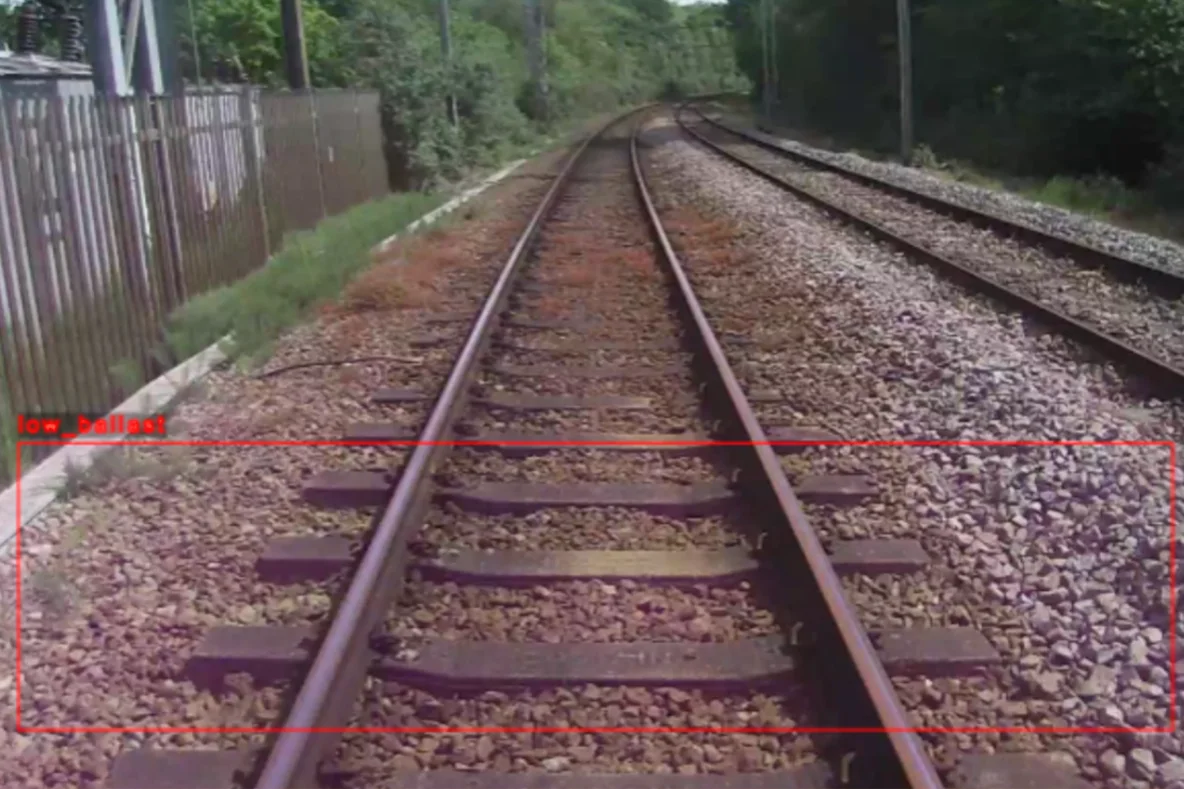
Remote identification of low ballast on the AIVR Platform – supporting proactive maintenance planning without trackside exposure.
Why it matters
Voiding matters because the affected sleeper is no longer able to share wheel loads as intended, so adjacent sleepers and ballast are overloaded and track movement increases. This can accelerate geometry deterioration, worsen ride quality, damage fastenings and ballast, and create a feedback effect in which repeated dynamic loading enlarges the void and spreads the defect longitudinally (i.e. along the track).
Where, when and who
Engineers have long encountered voiding as part of wider trackbed and support problems, especially in wet beds, contaminated ballast, transition zones and switches and crossings (S&C), where loading is less uniform and support conditions can change rapidly.
How it develops
Voiding usually develops when ballast settles, rearranges or becomes fouled, or when the underlying formation loses stiffness because of water ingress, weak soil or repeated dynamic loading. The result is a local cavity or loss of contact under part of the sleeper or trackbed, so the track initially ‘hangs’ over the unsupported area until a train load forces it down. That impact-like reloading increases deflection, damages the ballast structure, and transfers greater force to adjacent supports, which can make the void larger and the local stiffness variation more severe over time. If left uncorrected, voiding can progress into more serious track defects such as cracked/ineffective sleepers, broken joints and broken rails, as well as track geometry exceedances above actionable limits.
Monitoring and maintaining
Historically, low ballast was mainly identified through lineside inspections and Basic Visual Inspections, requiring staff to walk the line and record sites manually. Today, systems such as One Big Circle’s AIVR Ballast Condition Monitoring capture forward-facing video from in-service trains and apply in-house machine learning classifier models to automatically detect low ballast, scoring severity and flagging locations in map-linked reports for engineers. This enables remote, repeatable condition monitoring, supports targeted tamping, stoneblowing or ballast renewal, and helps reduce ‘boots on ballast’ while improving safety and efficiency on routes such as Network Rail’s Eastern Region, where low ballast and wet beds are being monitored as part of collaborative trials.