14/09/2026
How Machine Learning Is Changing the Way We Inspect the Railway

When One Big Circle introduced AIVR to the rail industry in 2019, our machine learning capability started with a single task: spotting graffiti in lineside footage to help Network Rail detect areas of potential trespass and damage. Since then, it’s grown into a suite of models, developed in-house and refined with input from rail experts. Those models now automatically detect and assess the location and condition of a multitude of asset types across every discipline – track, conductor rail, overhead line, signalling and lineside infrastructure.
AI and Machine Learning: What’s the Difference?
Both terms are used to describe AIVR’s capabilities, so it’s worth being clear on what each means.
Artificial Intelligence (AI) is the broad field of building systems that can perform tasks that would normally require human intelligence. Machine learning (ML) is a specific approach within that field: rather than programming a system with fixed rules for every scenario, we train a model on real examples until it learns to recognise the pattern itself.
AIVR: An End-to-End Rail Monitoring System
The machine learning models are derived from data captured by AIVR devices across the network. Our in-house teams train models directly on the millions of miles of footage, thermal imagery and line-scanning data AIVR captures, meaning every new detection capability is built on real operating conditions.
This matters particularly through seasonal change when leaf fall, frost and vegetation growth can all affect how a stretch of track or an asset can change over time. Our models are trained across the range of seasons and conditions, so detection stays reliable as the network changes.
Every detection is automatically mapped to its exact location on the network and made accessible online, so that each detection can be reviewed alongside a full history of that location, building into a continuous record of the network condition.
By reviewing analysed data online through AIVR’s secure online platform, engineers can complete desktop inspections that reduce the need for track access in some of the most constrained areas of the network. Time previously spent on travel and site visits is reallocated to the issues that need reviewing, supporting more targeted, and increasingly predictive, maintenance planning.
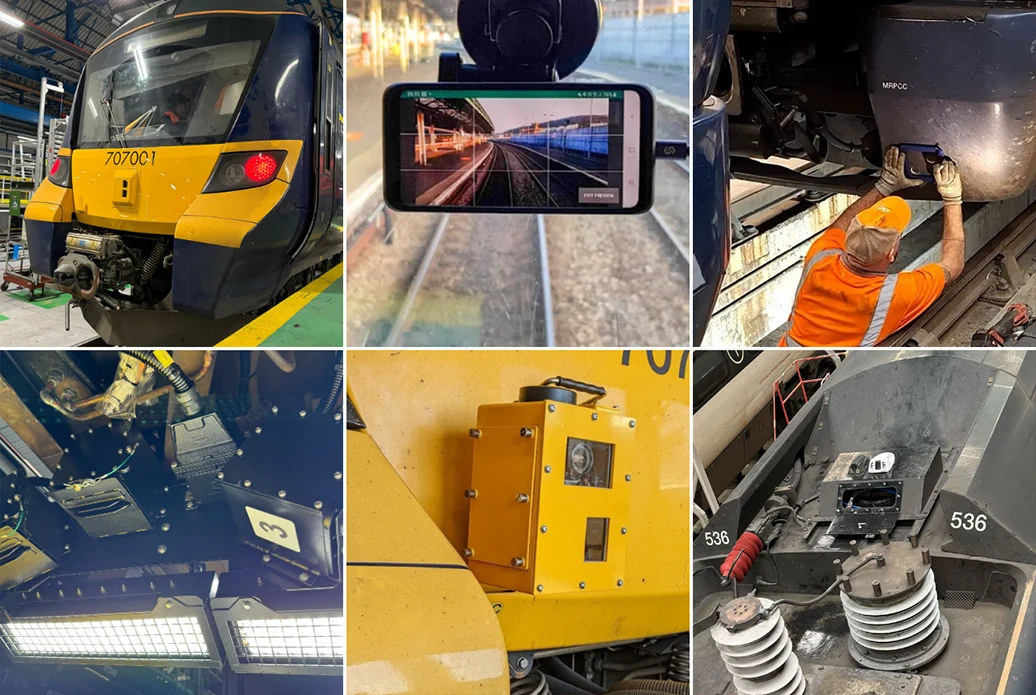
AIVR’s machine learning models are trained on the data captured by over 500 AIVR devices on the network, collecting a wide range of data to cover all aspects of the rail environment.
This end-to-end solution is built by our specialist team of video technology and AI experts. Their expertise spans hardware design, software development, computer vision, systems integration and scalable cloud infrastructure – the full stack behind every AIVR detection, from the camera on the train to the alert direct to the engineer.
To date, OBC has processed over seven petabytes of data and built more than 100 machine learning models to detect assets and conditions across the network.
Workers across the industry now have AIVR’s detections embedded directly in their workflows, through reporting, alerting and automated email notifications. This turns critical detections into actionable, evidence-based decisions. Remote review optimises resource allocation and maintenance planning, giving everyone who uses the railway the benefit of proactive maintenance. Early detection of issues allows intervention before safety hazards develop, preventing delays, disruption and higher costs.
AI-powered analysis processes the captured data automatically, enabling faults to be detected and scrutinised remotely. That means remedial work can happen at the first opportunity, and preventative maintenance can be planned before failures occur – with effort going where the data shows it’s needed. The result is an improved understanding of the rail environment, faults identified earlier before they escalate, and a more efficient, targeted approach to maintenance that increases safety for everyone involved.
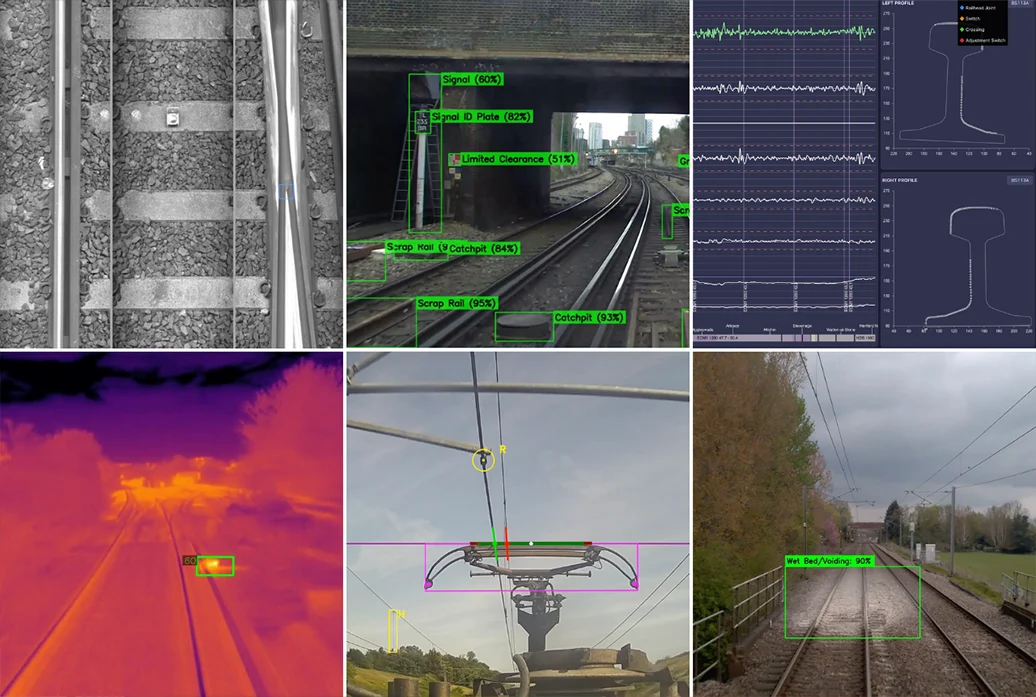
AIVR’s machine learning models cover the rail environment, mapping assets, detecting critical defects, and more, with the aim of increasing safety.
Monitoring the Track
On the running rail, our technology monitors everything from ballast and sleepers to the railhead, joints and more, supporting detailed track inspection and condition monitoring across plain line and switches and crossings alike.
Trained on imagery captured by our AIVR Focus line-scanning system, our machine learning models automatically detect and classify critical defects such as broken rails, cracked and corroding joints, and missing fastenings and bolts. They also find railhead issues such as squats, corrugation, and lipping.
Forward-facing video supports ballast condition monitoring, with machine learning used to identify wet beds, voiding, and areas of low ballast.
At switches and crossings, our machine learning capabilities extend to automated gap, heel and toe measurements for adjustment switches, and to seasonal joint surveys which flag issues before they become critical.
On the running rail our models help operators and maintainers with their climate resilience, with automatic detection and severity assessment of railhead contamination caused by leaf fall – a leading cause of low-adhesion events.
Track geometry measurements add a further level of precision alongside our machine learning detections. Critical parameters such as gauge, twist, alignment and level are measured directly, then automatically cross-referenced against our models’ output. The process matches rail profile data to the identified rail section, and correlates dip angles with nearby joints that our models have already detected.
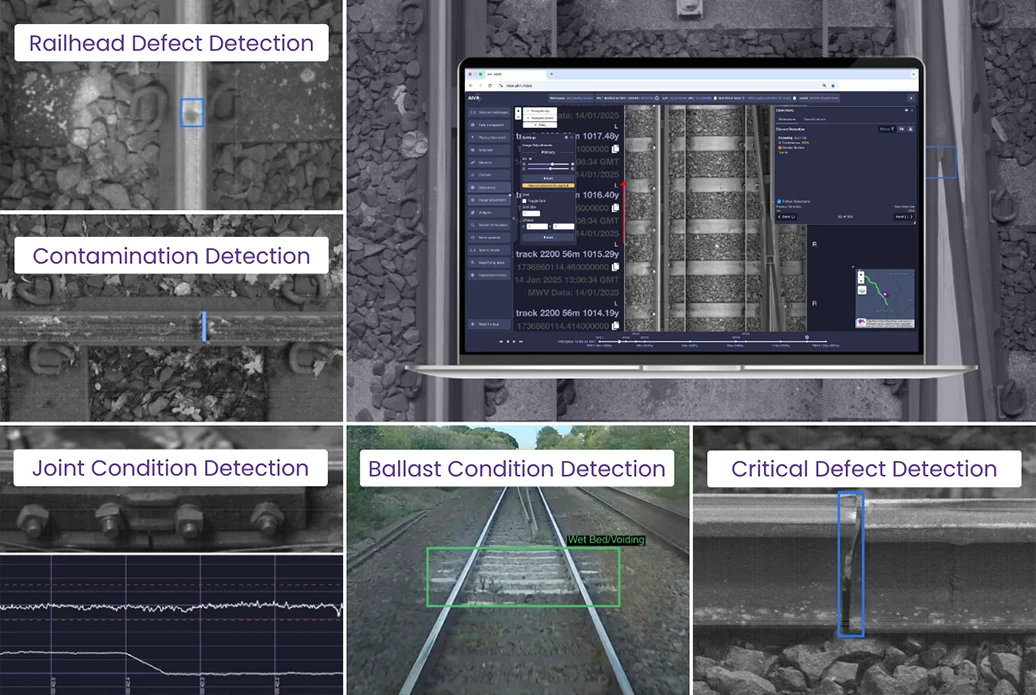
AIVR’s machine learning models automatically detect and classify track conditions – from railhead defects and rail contamination to joint condition, ballast condition and critical defects – all reviewable online.
Monitoring the Lineside Environment
Lineside and structure surveys combine forward-facing video, structural inspection video and AI detection for comprehensive infrastructure inspection, improving safety and reducing the need for site visits. The machine learning models applied in these use case automatically detect lineside assets such as signage, signals, limited clearance signs, LOCs and ballast bags, and also assess the condition of infrastructure assets such as troughing.
Our vegetation encroachment models track growth to enable proactive management and maintenance of safety clearance. They continuously monitor signal obstruction and corridor and overhanging vegetation, ensuring all incidences are pinpointed and mapped to identify high-risk locations requiring priority, aiding targeted maintenance and improving safety in approaching autumns.
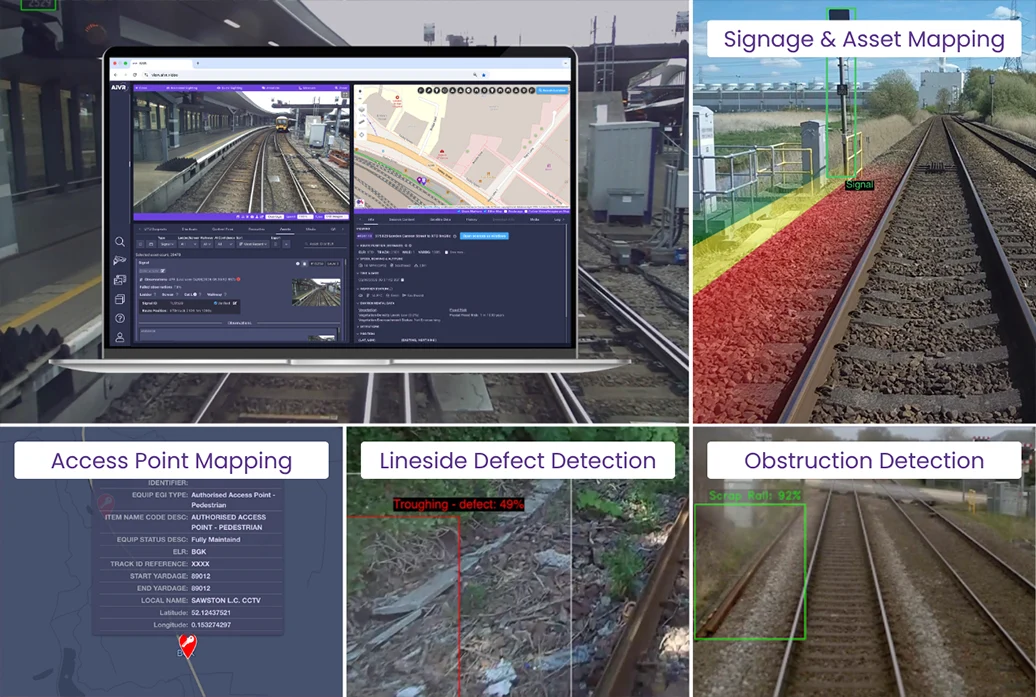
AIVR’s machine learning models support desktop surveys, vegetation encroachment monitoring, lineside defect detection and obstruction detection — from signage and signals to scrap rail identification.
Monitoring the Conductor Rail
AIVR’s machine learning capabilities extend to the conductor rail environment, imagery of which is captured by our AIVR CRVS system. The models to support this environment detect and assess anchors, CMS sleepers, cabling, insulator bases and insulator pots, welded and non-welded fishplates, guard boards, lug bolts and jointed rail ends. They also flag contamination, corrosion and ramp end creep.
AIVR Shoe uses computer vision frame by frame to trace its interaction with the running rail, generating height, stagger and vertical acceleration measurements and automatically catching electrical arcing – giving fleet and infrastructure teams a shared unique view of performance.
Our models also extend further, into thermal video where they track temperature exceedances on electrified infrastructure over time, mapping them geographically and classifying severity to trigger automated alerts before an issue becomes a failure.
Historical tracking matches repeat hot spot observations at the same location, to identify if the issue is changing or worsening and what levels of intervention are required.
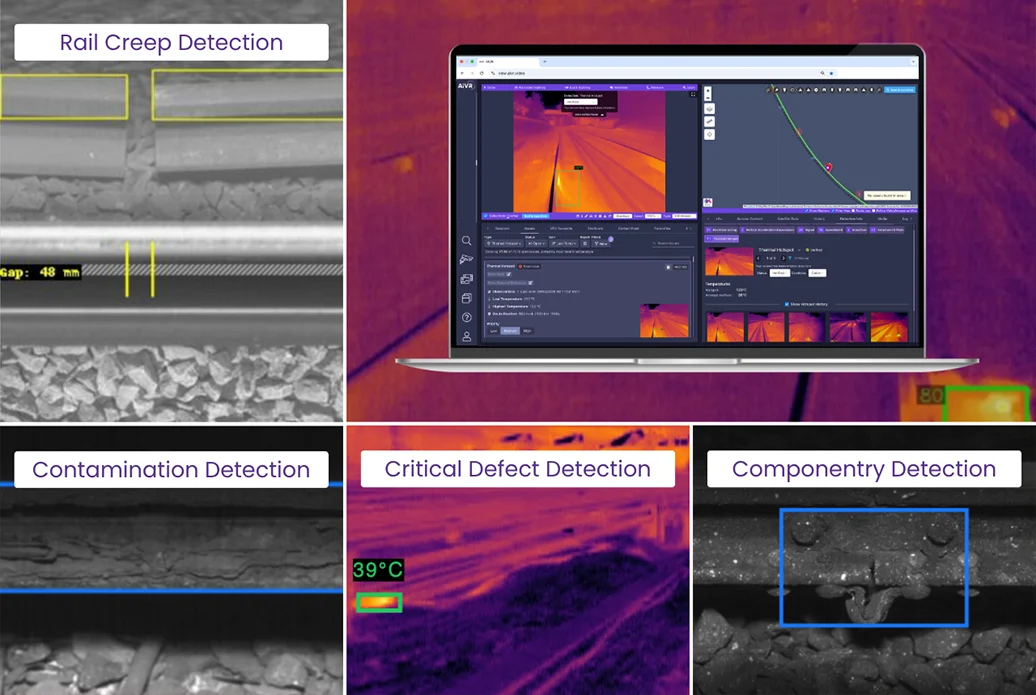
AIVR’s machine learning models automatically detect conductor rail conditions including rail creep, contamination, critical defects and componentry issues, reviewable online alongside thermal hotspot detections.
Monitoring overhead line equipment
For overhead line equipment, our models support an extensive visual inspection of overhead line infrastructure, including stanchions and pantograph equipment for OLE surveys.
Advanced detection models map OLE structures into an online inventory for quick review, alongside a full history of each asset. The models automatically detect splices and structures, assess dropper health, and flag incidences of arcing for early intervention.
Component monitoring gives a detailed evaluation of OLE components and connections for maintenance planning, including height and stagger measurements and cable connection assessment. Defect detection extends this further with AI-powered identification and tracking of OLE defects and anomalies, including arcing, corona discharge events, automated dropper detection, thermal exceedances and OLE geometry exceedances.
As with other cases above, the machine learning monitoring OLE helps improve climate resilience with environmental monitoring and predictive analysis including seasonal temperature modelling and tensioning preparation ahead of the conditions that put the most strain on the network.
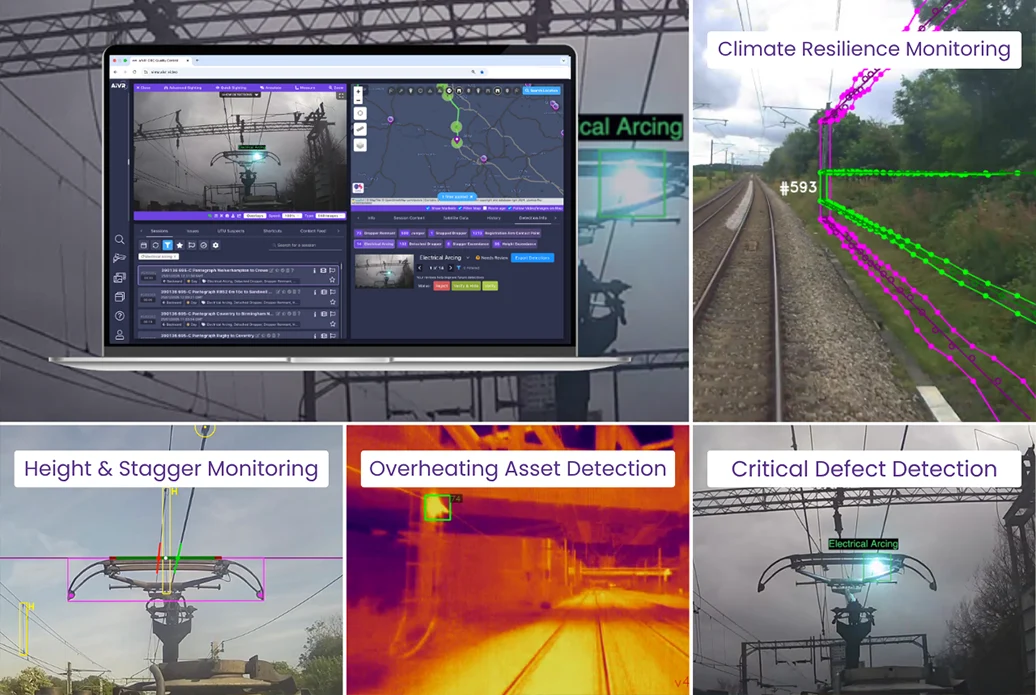
AIVR’s machine learning models support comprehensive OLE inspection – from climate resilience monitoring and height & stagger measurements to overheating asset detection and critical defect detection, such as electrical arcing.
Monitoring Signalling Assets
Our models have automatically detected, mapped and made searchable more than 25,000 signals across the UK network, alongside AWS magnets and cable conduits. A dedicated model also detects vegetation obscuring signal sightlines, flagging that risk for review.
Assisted signal sighting covers signal visibility verification and virtual route patrols, helping teams verify signal sighting plans and identifying visibility issues for driver safety. Augmented reality signal placement lets planning teams visualise new or relocated signals virtually before committing to a design.
Component monitoring extends automated identification and mapping to further signalling assets across the network, including cable detection and axle counter monitoring.
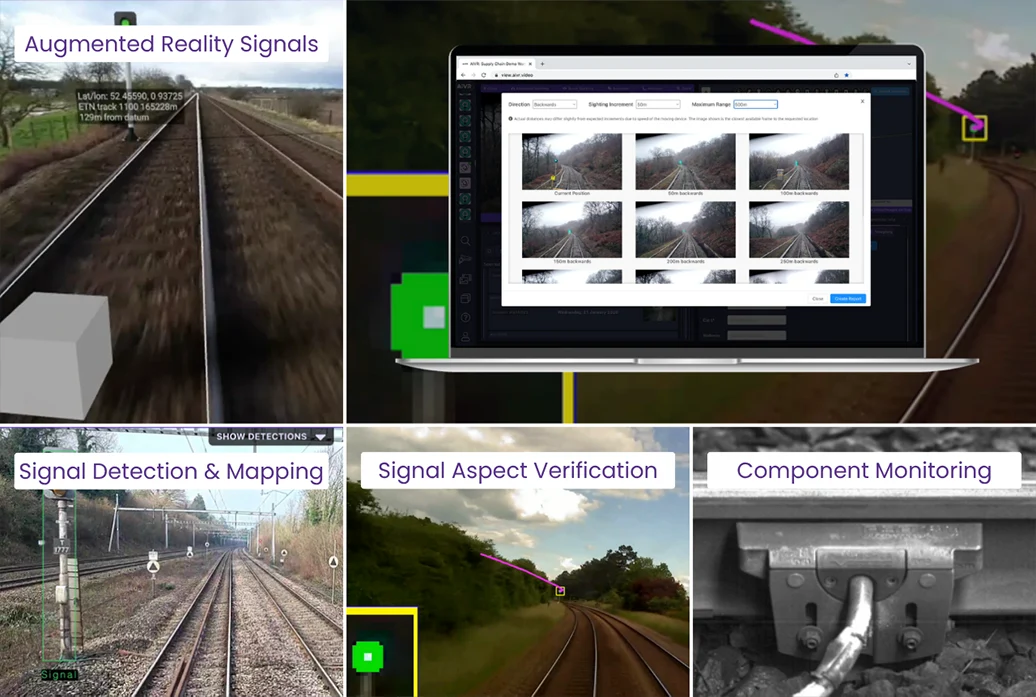
AIVR’s machine learning models support signalling inspection, from augmented reality signal placement and signal detection & mapping to signal aspect verification and obscuration detection.
Looking Ahead
The aim of these models is to focus expert attention where it’s needed most – flagging the detections that matter so that engineers can review, verify and act on them more efficiently and effectively.
Our machine learning team works hand-in-hand with rail engineers, infrastructure owners and technology partners so AIVR’s models continue to reflect the real conditions and priorities of the network they serve.
The result, discipline by discipline, is the same: fewer manual inspections, faster routes from data to decision, and a safer railway.