PLPR (Plain Line Pattern Recognition)
What is it
Plain Line Pattern Recognition (PLPR) is a machine-vision based system that inspects continuously welded ‘plain line’ railway track from monitoring trains as an alternative to routine manual walking inspection. High-speed line-scan cameras and associated sensors capture detailed images of rails and fastenings, which algorithms analyse to flag potential defects for expert review.
PLPR focuses on components such as clips, rail clamps, pads, ballast condition and other visible features on straight or gently curved track, complementing separate systems for switches and crossings. The service is now integrated with track geometry and asset databases so that the majority of inspected plain line track has an auditable condition record.
Why it matters
PLPR improves safety by removing many patrolling staff from ‘red-zone’ working, reducing exposure to moving trains while still providing regular inspection coverage. It also enables earlier detection of issues like missing fasteners or poor ballast that could otherwise contribute to broken rails, geometry faults or derailment risks.
The technology increases inspection frequency and coverage. In 2019 Network Rail stated that PLPR-equipped trains had replaced manual inspections on around 8,500 miles of Britain’s track, with potential to reach about 15,000 miles. Network Rail also reported that this more targeted, data-driven maintenance was saving taxpayers millions of pounds over each control period [read more here].
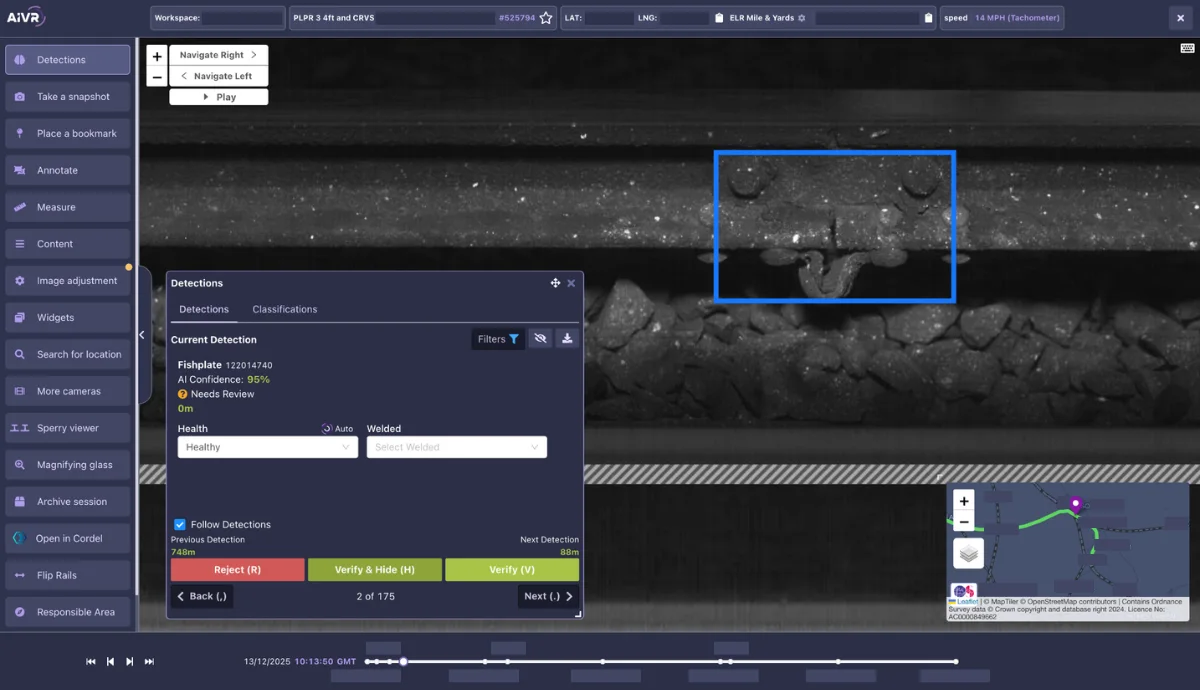
Conductor rail captured for remote inspection by AIVR Focus on a PLPR vehicle.
Who developed PLPR and when
PLPR in the UK was originated as a proof‑of‑concept by Loughborough University, then industrialised and developed into a production system for Network Rail by Omnicom Balfour Beatty, with Network Rail owning and operating the PLPR system on its infrastructure.
PLPR was developed over roughly three years of trials on sections of the West Coast Main Line, leading up to a national launch announcement in October 2012.
Subsequent milestones include opening a dedicated PLPR facility in Derby, and a second facility in January 2019 to expand capacity and resilience. By the early 2020s, PLPR deep-learning upgrades were in routine use, significantly reducing false positives in defect detection.
Where it us used
Within Britain, PLPR is deployed as a national service across Network Rail’s regions: Eastern, North West & Central, Scotland’s Railway, Southern, and Wales & Western. A fleet including the New Measurement Train and other monitoring trains regularly inspects plain line track on key main lines and many secondary routes.
Similar concepts have been adopted internationally, for example on heavy-haul and metro systems in Switzerland, a Rio Tinto mining railway in Brazil and a metro in South Korea. However, the UK implementation is broader in scope, being applied across a large, mixed-asset national network rather than just uniform newer lines.
How it works
A PLPR rig typically combines arrays of line-scan cameras (such as AIVR Focus), lasers and thermal cameras (such as AIVR Thermal) mounted beneath measurement trains, synchronised with odometry and track geometry data. As the train runs at up to 125 mph, the cameras capture an image roughly every 0.8 mm of track, equating to about 70,000 images per second [read more here].
Computer vision and pattern-recognition algorithms classify components and identify anomalies such as missing or mis-seated fasteners, excess or deficient ballast and other visible defects, often now supported by deep-learning models to reduce false positives. Suspected issues are queued to specialist inspectors in Derby, and confirmed defects are sent to local track maintenance teams so that targeted interventions can be planned in possession windows.