Ultrasonic Testing (UT)
What is it
Ultrasonic testing (UT) is a non-destructive testing method that sends high-frequency sound waves into a material and interprets reflected signals to reveal internal defects. It is widely used in rail infrastructure monitoring, and in sectors such as weld inspection in oil and gas pipelines, aircraft structural integrity checks, and power generation components.
Why it matters
For rail, UT is a primary means of detecting internal rail defects such as transverse fatigue cracks, bolt-hole cracks and vertical split heads before they lead to rail breaks. Early detection supports interventions such as grinding or replacement, reducing derailment risk and enabling condition-based maintenance strategies on intensively used routes.
UT data streams can be synchronised with data streams from other infrastructure monitoring devices for a comparative approach that strengthens fault diagnosis. For example, in railways, detailed images from the AIVR Focus line-scanning system can be synchronised precisely with UT data, allowing engineers to see images of suspected track faults detected by UT. This service is used by Network Rail.
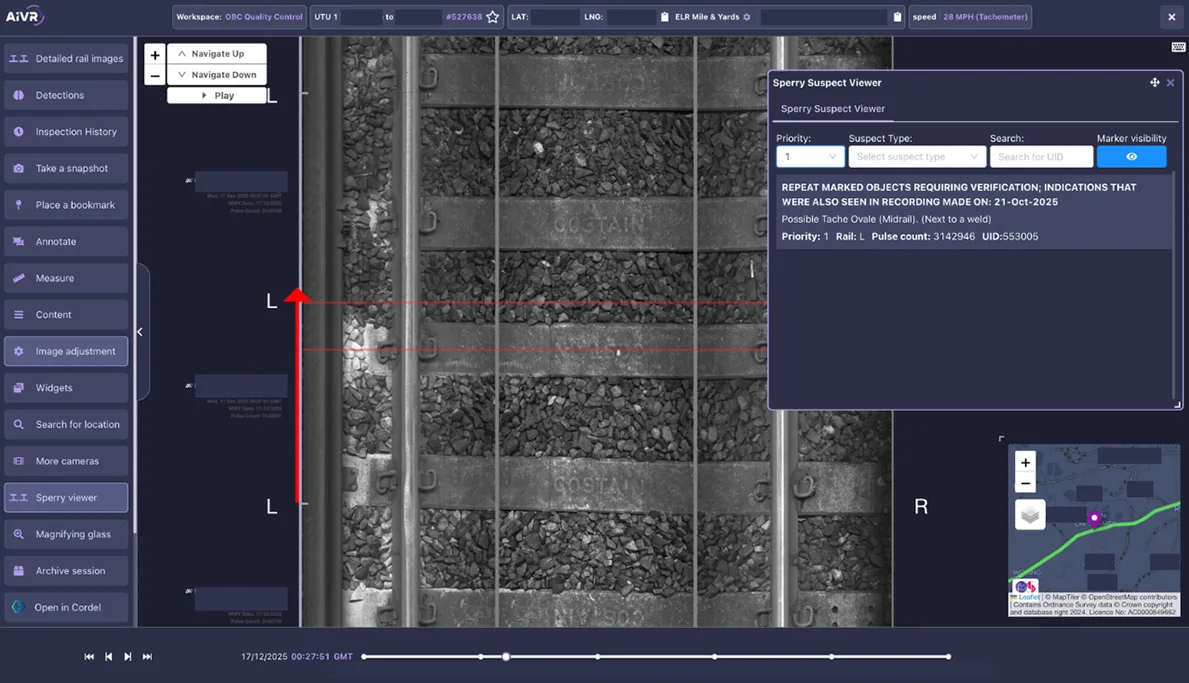
AIVR track imagery synchronised with Sperry Rail ultrasonic testing data.
Who uses it
Within rail, UT is used by infrastructure managers (e.g. Network Rail Asset Information and Route Asset Managers), specialist rail testing contractors (such as Sperry Rail and others), and NDT technicians certified to rail-specific procedures. Data users include track engineers, maintenance planners and safety assurance teams who turn defect reports into workbanks (detailing planned works) and speed or traffic restrictions.
Where it operates
UT is applied on mainline, metro, light rail and heavy-haul freight networks in Europe, North America, Asia and Australia as a standard part of rail inspection regimes. In the UK it is deployed across Network Rail infrastructure using train-borne ultrasonic test units (UTUs), road-rail vehicles and manual walk-through testing, with similar fleets operated by other infrastructure managers worldwide.
When it was introduced
Commercial ultrasonic flaw detectors emerged in the mid-1940s, notably the Supersonic Reflectoscope in 1945, quickly gaining industrial acceptance. Ultrasonic rail flaw detection was introduced to US railways in 1949 by Sperry Rail Service and was embedded across its inspection car fleet by the 1960s. British Rail’s dedicated ultrasonic test train entered service in 1970, with modern UTUs following on the UK network.
How it works
A UT system uses a transducer to inject ultrasonic pulses, typically in the 0.5 to 10 MHz range, into the rail head, web and foot via contact, wheel probes or non-contact guided-wave/EMAT configurations. Discontinuities and boundaries reflect part of the wave energy, which is converted back into electrical signals and displayed as time-amplitude traces or B-scans; automated processing then classifies and locates defects for engineers to act upon.