What are they
In rail engineering, squats are localised rolling contact fatigue (RCF) defects that form on the rail running surface, usually within the main wheel‑running band rather than out at the gauge corner. A mature squat typically appears as a dark, roughly oval or lens‑shaped patch with fine surface cracks and, in many cases, a slight depression or raised lip at the edges where material has plastically deformed or broken away.
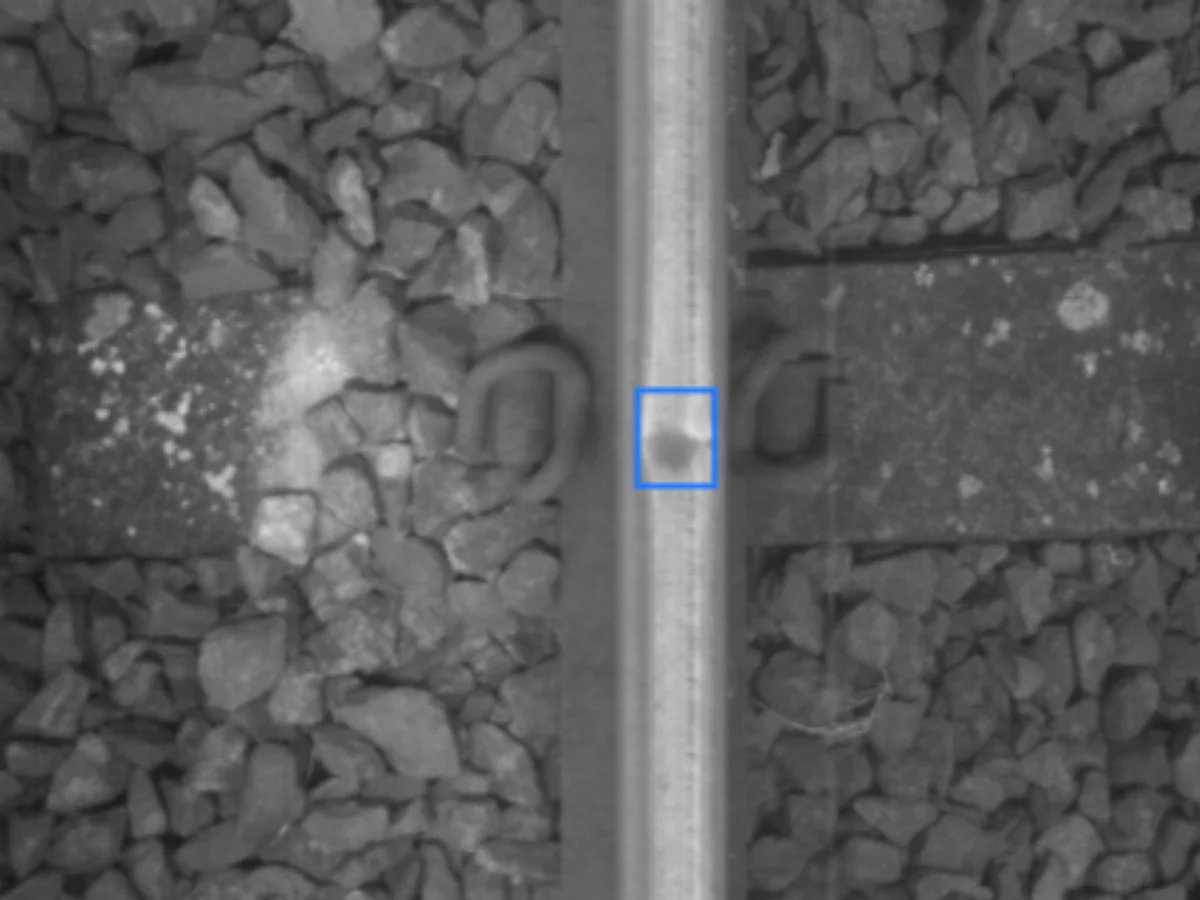
Squat detected by Machine Learning on the AIVR Platform.
Why they matter
Squats are important because they concentrate stresses and can evolve from relatively benign surface marks into deeper fatigue damage that affects the railhead’s structural integrity. As they grow, squats create impact loads, increase noise and vibration, accelerate wear on both rail and wheel, and can contribute to more serious RCF cracking or spalling if not detected and managed.
Where, when and who
Squats are often found on heavily trafficked lines, especially under high axle loads, frequent braking and traction, or where there are small surface discontinuities (e.g. from minor defects, mill scale, or historic damage) that act as initiation sites. They have been widely studied in Europe, Australia and elsewhere as one of the key RCF defect families, alongside head checks and gauge corner cracking, and are a particular concern on high‑speed and commuter routes where ride quality and noise are closely scrutinised.
How it works
A squat typically initiates when a small disturbance in the contact patch – a tiny surface defect, hardness variation or residual stress field – focuses the stresses from repeated wheel passages into a local zone. Over many cycles, micro‑cracks form just below or at the surface and grow in a characteristic pattern:
- Near‑surface cracks spreading along the running band
- Downward‑growing cracks beneath the defect
Together, these can create a quasi‑elliptical damage zone. As cracks link and material loses support, pieces can chip out (spalling) and the surface may show a visible hollow or roughened patch.
Monitoring and maintenance
Squats are monitored through a combination of high‑resolution visual inspection (including train‑borne imaging), acoustic or vibration signatures, and non‑destructive UTU ultrasonic testing where appropriate.
Remote condition monitoring systems are designed to detect squats and other defects.
The automated, video‑based AIVR Focus system uses high-quality linescan imagery to algorithmically identify railhead faults including squats. AI flags squat candidates as visual suspects, which are then presented to human examiners for verification. The system has demonstrated the ability to detect squat defects that may not be identified through UTU testing.
Maintenance strategies typically involve rail grinding or milling to remove the damaged surface layer before cracks grow too deep, combined with controlling wheel–rail contact conditions (profile management, lubrication/friction management) and, when necessary, rail replacement.