17/06/2026
Safer Overhead Line Equipment Monitoring: Day 3 of Rail Safety Week 2026

Why Overhead Line is a Safety Challenge
Electrification teams working on or near overhead line equipment face a unique combination of dangers. They are working at height, in exposed locations, often in poor weather and in close proximity to high voltage equipment that carries 25,000 volts. Even when network sections are isolated and earthed, the physical demands of accessing, assessing, and recording the condition of overhead equipment are significant – on a busy electrified network, the windows available for safe access are tight and often at nighttime.
The overhead line system is also one of the most mechanically complex assets on the railway. Wires, droppers, registration arms, tensioning systems, section insulators, and associated steelworks all need to be regularly inspected and maintained. Seasonal changes place particular demands on the system, where temperature fluctuations cause wires to expand and contract, affecting electrical and mechanical clearance limits; increasing extreme weather events can compromise the integrity of the system across entire route sections. Having frequent and up-to-date visual information can help to support engineering teams to identify signs of deterioration, to make interventions early and plan for seasonal change in advance, helping to avoid the likelihood of a catastrophic failure.
The safety imperative is keeping OLE engineering teams safe during inspection, and keeping the infrastructure in a condition that is functioning and reliable for everyone who uses it.
How Virtual OLE Inspection is Increasing Safety
AIVR supports engineers to undertake digital, desktop-based OLE inspections – helping to reduce the need for on-foot inspections to monitor the overhead infrastructure. This is achieved through high-frequency video capture of OLE infrastructure from in-service trains and maintenance vehicles, providing a continuous, near real-time view of the overhead line network without any requirement to undertake inspections on site. Engineers are thus able to make the decisions they need to ensure infrastructure continues to perform safely, while also maintaining their own safety, by providing the means to monitor the infrastructure from their desktop.
Multiple data streams are utilised and available to AIVR users. These include forward-facing video, which captures imagery of the broader OLE corridor and surrounding environment; and pantograph cameras, which capture imagery of the pantograph interacting with the contact wire during operational service. Together, they offer engineers a real-world picture of OLE conditions across the electrified network, accessible remotely and safely via the AIVR Platform.
Capabilities Across the OLE Network
Remote OLE surveys
Desktop OLE patrols using forward-facing, overhead and pantograph video data allow engineers to carry out comprehensive visual inspections of overhead line infrastructure without trackside access – significantly reducing the requirement for staff to work in hazardous environments near live OLE.
OLE structures are detected and are automatically mapped and assigned searchable asset IDs – giving engineers a structured, navigable record of OLE infrastructure across a given area of the network. This digital inventory allows OLE engineers to easily search and review specific infrastructure and perform routine condition assessments, and inform targeted maintenance planning. AIVR also facilitates easy access to historic video data, offering teams a digital log of the infrastructure across the seasons to review and monitor changes over time.
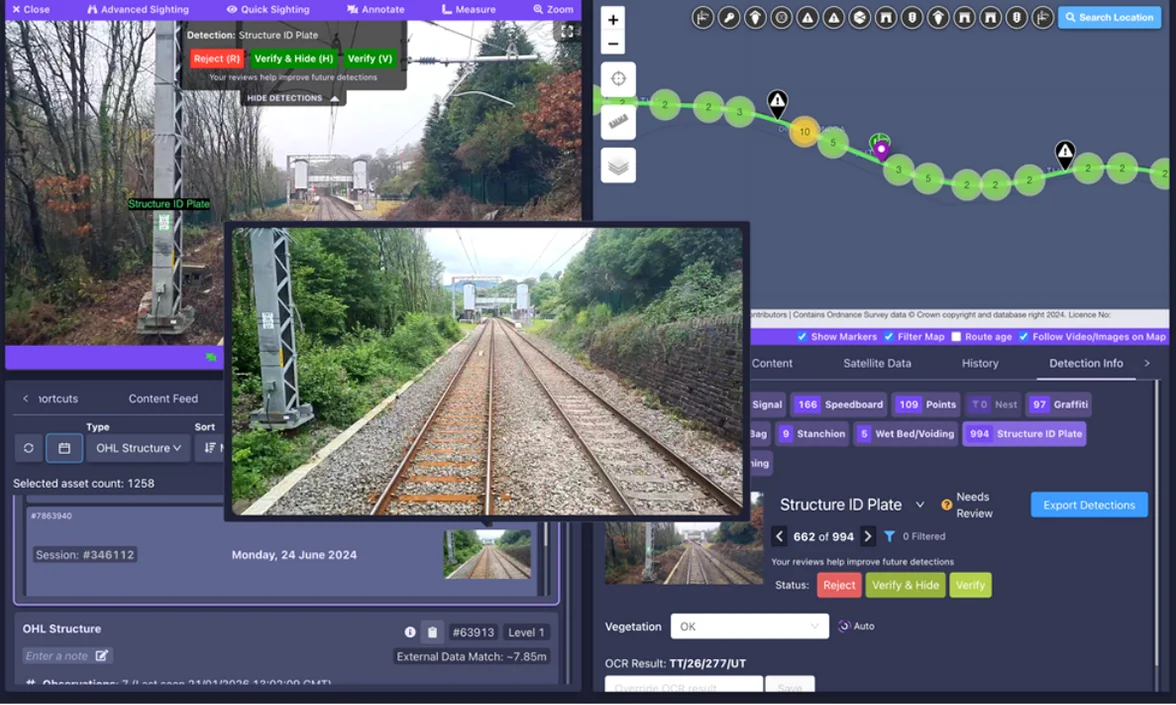
OLE structure detection and mapping on the AIVR Platform – structures automatically identified, assigned searchable asset IDs, and mapped across the network for remote survey and condition monitoring.
Automated Measurement Systems
Height and stagger measurements are automatically generated using a Computer Vision approach. Using pantograph video data, the visible interaction between the pantograph and the contact wire is automatically plotted and used to output measurements. This data is presented in the AIVR Platform as a visual trace, and correlated to nearby OLE structure information. It may be viewed simultaneously with the available video data. This capability offers engineers a comprehensive picture of potential exceedances or accelerations during the vehicle’s operation, helping end-users to review and assess performance from their desktops using real-world data.
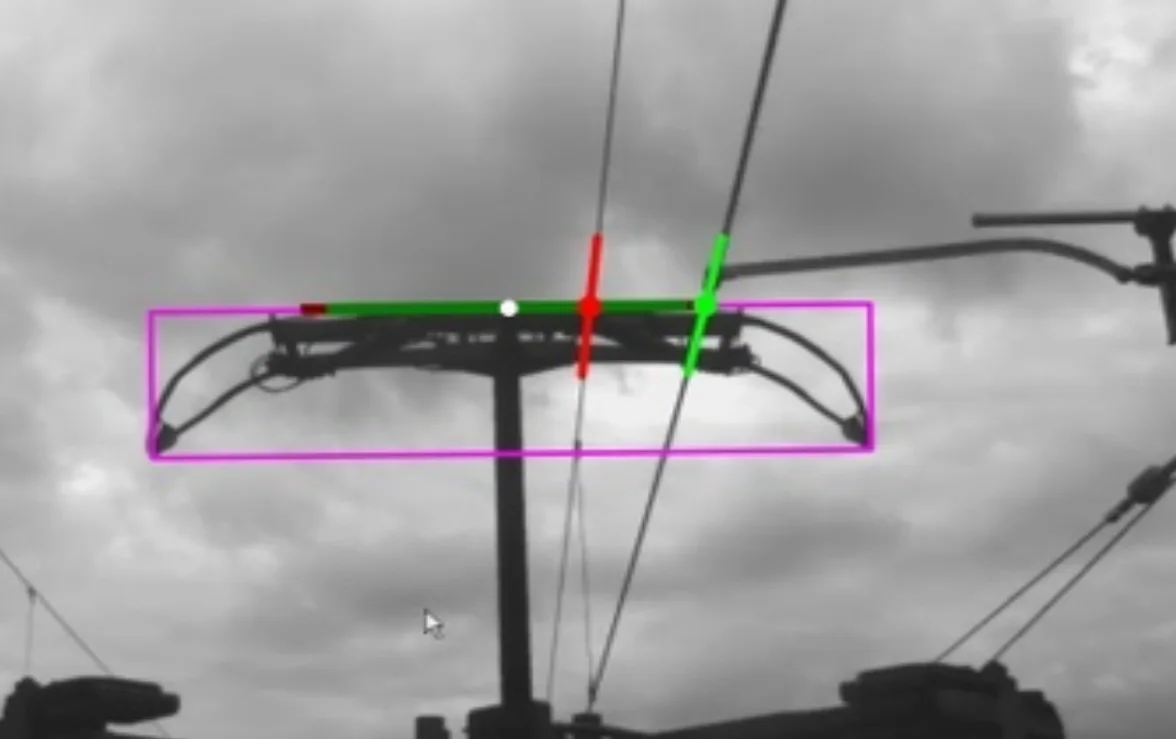
Height and stagger measurement on the AIVR Platform – continuous geometry monitoring of overhead line equipment captured via pantograph camera, with exceedances automatically flagged.
Defect Detection
AIVR also offers AI-powered detection and tracking of OLE defects and anomalies in the available video imagery. Examples include detections of electrical arcing events during operational service and dropper health conditions (e.g. snapped or missing).
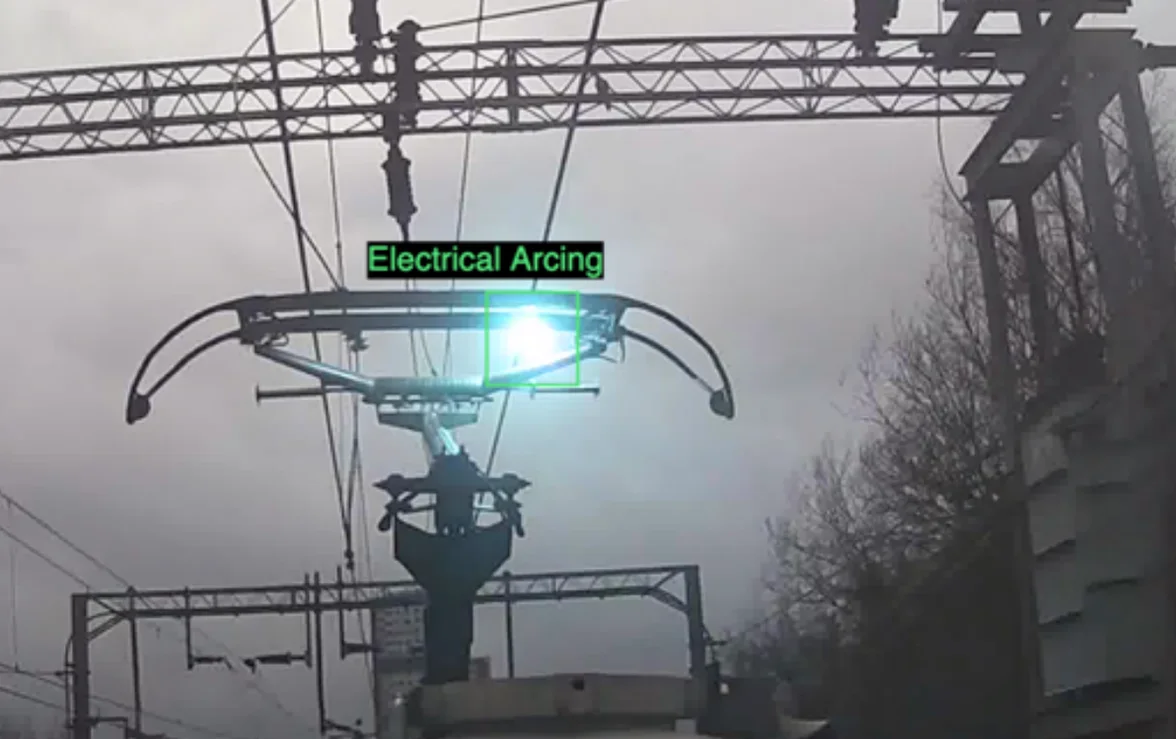
Electrical arcing automatically detected on the AIVR Platform –early identification of arcing events supports rapid intervention before damage escalates to infrastructure or pantographs.
Thermal imaging cameras are also deployed to identify heat anomalies invisible to the human eye. Temperature exceedances often indicate developing electrical faults before they lead to failure or fire risk, but are often difficult or impossible to identify through on-site visual inspection. Using specialised thermal imagery and AI, overheating assets can be automatically identified in AIVR and alerted to engineering teams prior to failure, so predictive interventions or targeted on-site investigations can be planned. This approach is helping to ensure infrastructure at greater likelihood of catastrophic failure can be managed and resolved without putting passengers or engineers at risk.
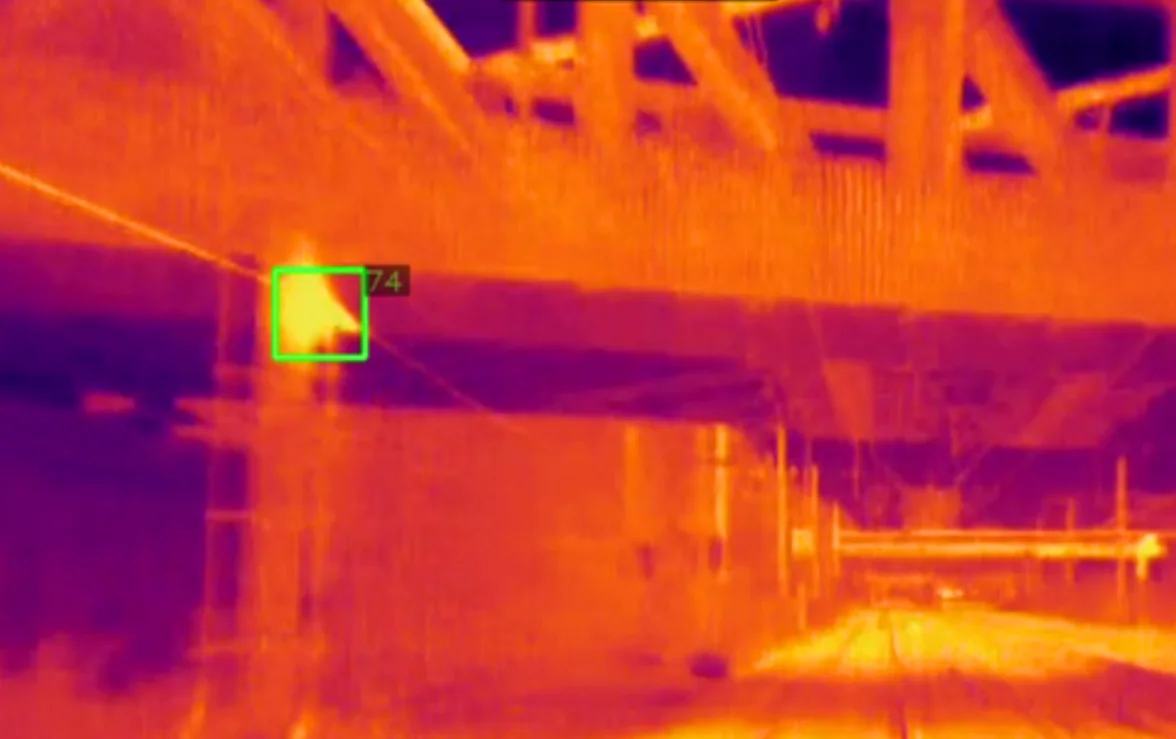
Thermal imaging of overhead line equipment on the AIVR Platform – detecting overheating electrical assets remotely before they cause failures or service disruption.
Seasonal Preparation
AIVR supports environmental monitoring and predictive analysis for proactive OLE management. AIVR provides automated balance weight asset identification and position measurements, generated using intelligent analysis on the visible data. Temperature modelling of tensioning assets helps to support adjustments to be made ahead of seasonal extremes, reducing the risk of wire-related failures during hot summers or cold winters.
Vegetation encroachment along OLE routes is also monitored and detected. Left unmanaged, vegetation can cause contact wire strikes, equipment damage, and unplanned service disruptions, so early detection supports proactive clearance before issues escalate.
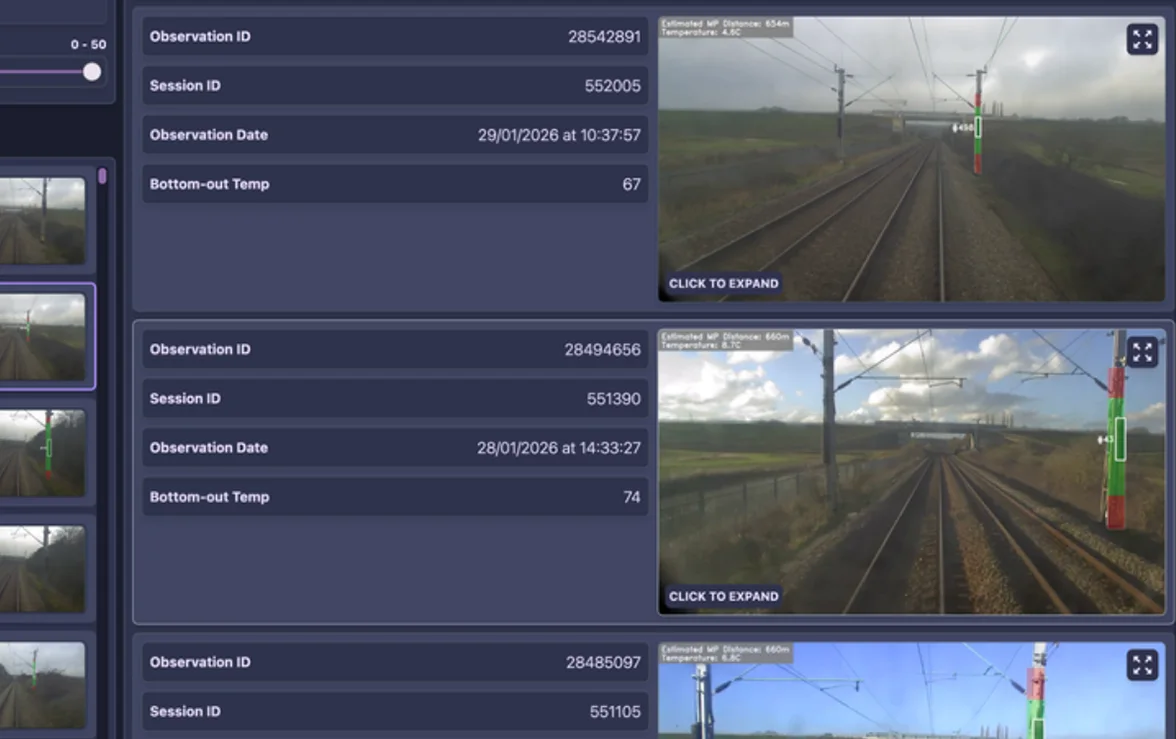
OLE condition history on the AIVR Platform – reviewing the same location across multiple sessions to track changes in component condition and support seasonal preparation.
Preparing for Safer Site Visit
When physical access to OLE structures is necessary, remote inspection plays an important role in making that visit as safe and efficient as possible. Forward-facing video allows teams to review the exact site remotely before attending – identifying access points, checking access boundaries, familiarising themselves with the specific structures involved, and annotating hazards for the team.
All findings are exportable as imagery, PDF reports, video and CSV, which can be shared ahead of attendance – so the team arriving on site is informed, prepared, and clear on what they are there to do and risks they face.
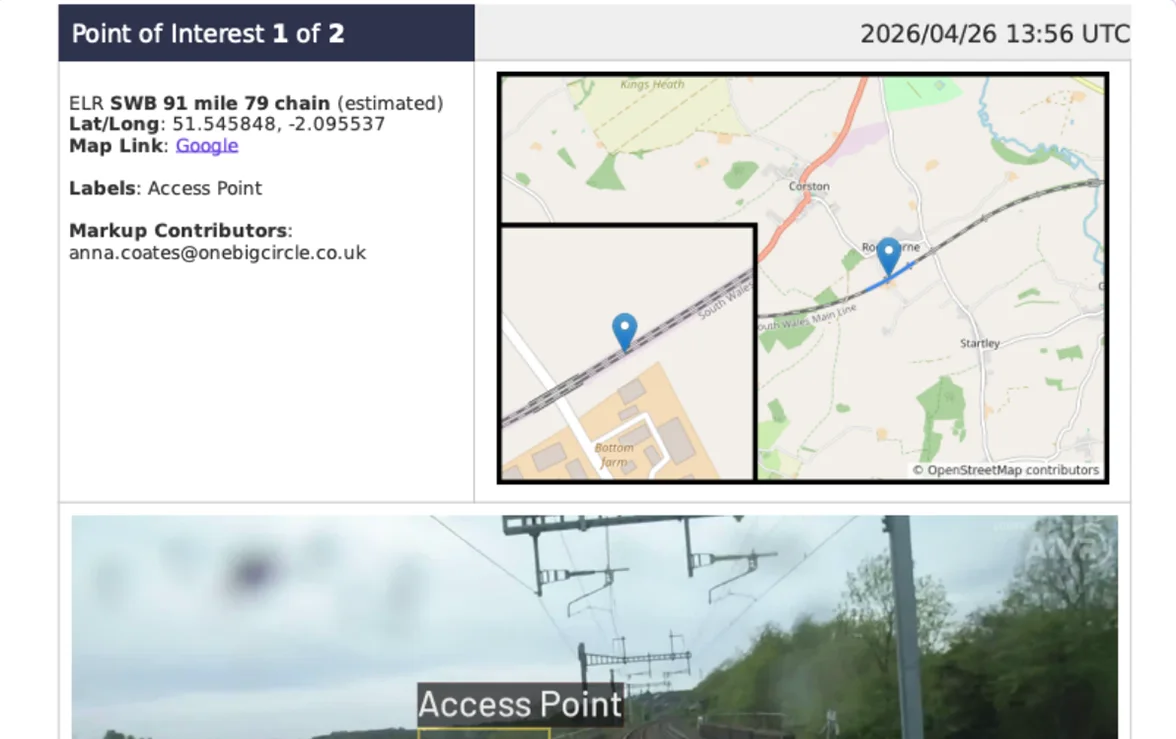
Automated report export from the AIVR Platform – with precise location data to support safe site planning.
The result is fewer electrification teams working at height, more of the network monitored more consistently, and a maintenance approach that is informed and driven by helpful data to catch issues before they become failures.