16/07/2026
Rail Live 2026: Reflecting on a Brilliant Few Days

It’s hard to believe it’s nearly a month since Rail Live wrapped up – but with the dust well and truly settled, we wanted to take a moment to reflect on what was another brilliant show for the One Big Circle team.
As always, this year’s show brought together the rail industry’s engineers, asset managers, operators and more for two days of live demonstrations and genuinely useful conversations. For us, it’s always one of the highlights of the calendar – a chance to speak directly with the people using AIVR day-to-day.
A Few Highlights
The OBC team was busy from the moment they stepped onto the site on Wednesday morning, to the moment they left on Thursday afternoon; a handful of moments from the show stood out:
- Our specialised survey trailer was on display, showcasing AIVR Focus’s line scanning and forward-facing cameras installed in partnership with Network Rail.
- We hosted members of the DfT Operator on the stand, talking through how AIVR fits into the future of the rail industry.
- A number of our brilliant new starters – from tech, support, commercial, and beyond – got stuck into their first rail industry event.
- We joined a roundtable hosted by Bauer Media Group, where industry experts discussed what AI actually means for the rail sector.
- With the show falling during Rail Safety Week, we spent time talking through the role AIVR plays in keeping the railway safer for everyone.
It capped off a genuinely busy, brilliantly chatty few days – catching up with fantastic customers old and new about how they use AIVR and the benefits it brings to their role.
Feedback Straight From the Stand
Senior Performance Manager, Avanti West Coast:
“Using AIVR is unrivalled. It gives us access to our entire 774-mile network, from Holyhead to Glasgow to London — the eyes and ears of the driver, with the ability to go back in real time and see exactly what they see: vegetation, signal sequences, everything. Performance is ultimately about making a better railway, a better operation, where we’re delivering for our customers. Having that real-world view the driver sees daily gives us the ability to understand signalling sequences and potential vegetation risks — we can screenshot and screen record it, and share that with Network Rail, not to point fingers, but to help build a better railway together. Having GPS, ELRs, miles and chains means we can pinpoint the exact location where sighting might be compromised, and really show our drivers and operational staff that they’re being heard.”
Permanent Way Design Engineer, Tony Gee:
“AIVR is a key element of my role in terms of collating information. We’re quite limited on resources when it comes to site survey, so if there’s anything I’ve missed, or I need additional information during design work, it’s super helpful — logging on to a cab ride video, having a look at lineside features, anything that might inform a report or piece of design work. It’s a daily used tool, and the interface really helps with gathering all the information I need.”
Senior Programme Manager, Network Rail:
“We are about to release our integration [Insight] back to One Big Circle [AIVR]. All our customers are very excited. It optimises their ability to utilise both products together, save some time, and gives them the ability to look at the defects and the latest video, which is going to improve, predict and prevent, and move us more to proactive maintenance.”
OLE Engineer, CRSA/AtkinsRéalis:
“Where we’re not able to get site photos, we’re able to use AIVR to put ourselves back on the railway and understand what infrastructure is out there. What’s really good is that it’s up to date — we’re able to run a route again, and on recent projects we’ve found new pieces of infrastructure that we weren’t aware had been installed. Rather than being out on site in the evenings, we can have live daytime footage from as recent as last week.”
CRE (Trackside), Colas Rail:
“Predominantly, we use AIVR for replacing site walkouts — particularly now we have to use line blocks all the time. It’s much more convenient and safer to have a recording of the entire site, at all times of year. It’s great for vegetation, signal sighting, track condition, and structures in the area — the track componentry side of it especially, which we’d hope will replace our site inspections.”
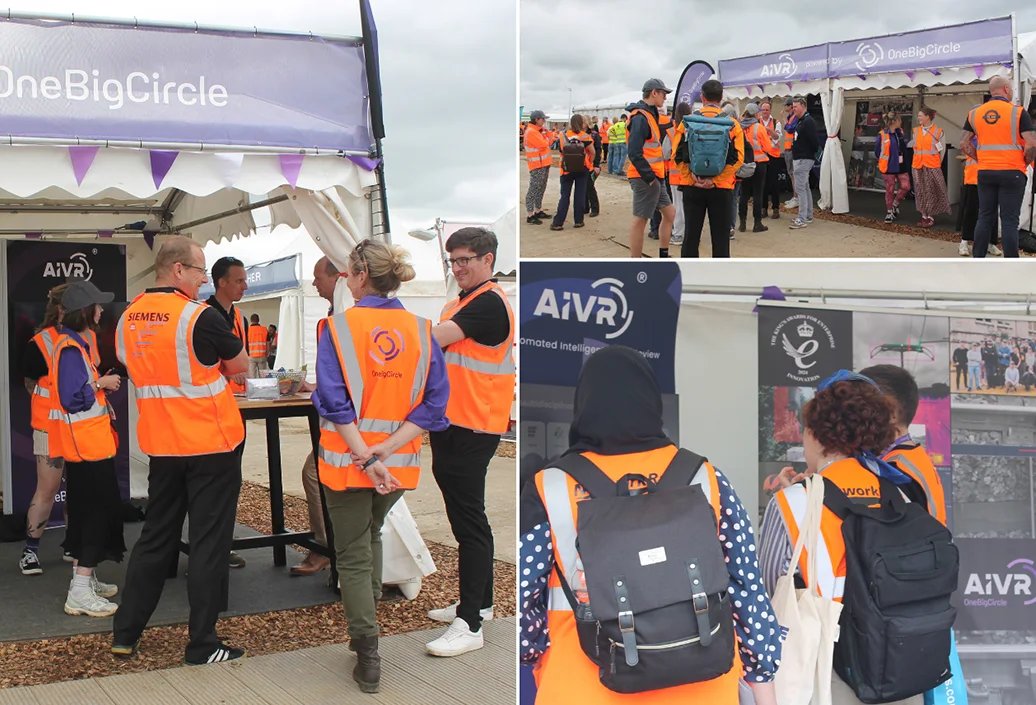
Visitors stopping by to see AIVR in action.
Section Manager, Network Rail:
“AIVR is massive for me — I use it for both sides of my job. For rail testing, I can check defect markings and clamp condition before welders or inspections go ahead. For lubrication, I can check plunger activity and grease exposure from the side imagery before sending a team down, so they’ve already got the visual evidence of what’s needed to fix it straight away. Yeah, I’m a big fan. Big fan.”
Lead Engineer, Colas/SRSA:
“I use AIVR to have a look at site so we don’t have to require line blocks to download videos. The videos can have annotations, so we can show signals, access points, RRAPs, and take measurements to adjacent tracks — I make good use of the safe cess tool to show that sites can be walked separately. It’s just a really useful tool.”
Nottingham Technical Team, Network Rail:
“We use AIVR pretty much every day. It’s a really good tool to save us going on track — access is tough now. We use it for checking potential defects, rough rides, and the general condition of the track, and for measuring — we use that a lot. It saves us a load of time, saves going out on track all the time. Yeah, I definitely recommend it.”
Graduate Signalling Engineers, Network Rail:
“I’ve mainly used AIVR to check point ends, whether they have Schwihag rollers fitted, which helps maintenance teams schedule what kind of maintenance is required and at what intervals. We use it for everything from checking the state of assets to checking access for planning work — anything that stops our guys from having to get out on the ground helps to improve safety massively for us.”
Signalling Designer, Digisig Rail:
“We use AIVR every day of work. I use it to do all the measurements for emergency speed restrictions, or when we start a project, to get an idea of what the infrastructure looks like. It’s a great tool to use — saves so much money and time.”
Freight TPR, Network Rail:
“The way I use AIVR is for identifying signals and looking at the layout of junctions. I use it probably every day, some days more than others. I find it a really useful tool to do my job — I don’t think there’s anything else we could use in that way, apart from cab videos on YouTube. If we didn’t have it, it’d be like losing a hand — it’s that useful to us.”
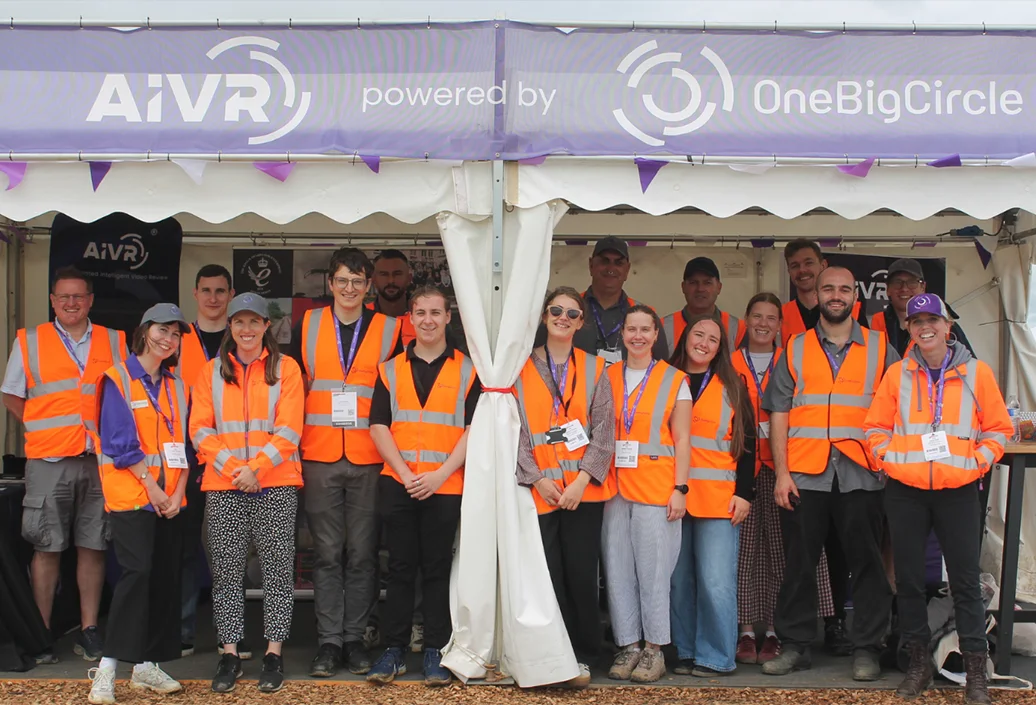
The OBC team at Rail Live 2026.
Thank you to everyone who popped by, asked questions, and shared what’s happening on your patch of the network. If we didn’t get to speak with you this year, or you’d like to pick up a conversation from the show, get in touch at enquiries@onebigcircle.co.uk — we’d love to hear from you.