Artificial Intelligence
What is it
Artificial intelligence (AI) is the field of computer science focused on creating systems that can perform tasks that typically require human intelligence, such as perception, reasoning, learning and language understanding.
These systems learn patterns from data and then use those patterns to make predictions, classifications or decisions without being explicitly programmed for every scenario.
In rail infrastructure monitoring, AI refers to algorithms and Machine Learning models that automatically interpret images and sensor streams from track, trains and wayside equipment to assess asset condition and risk.
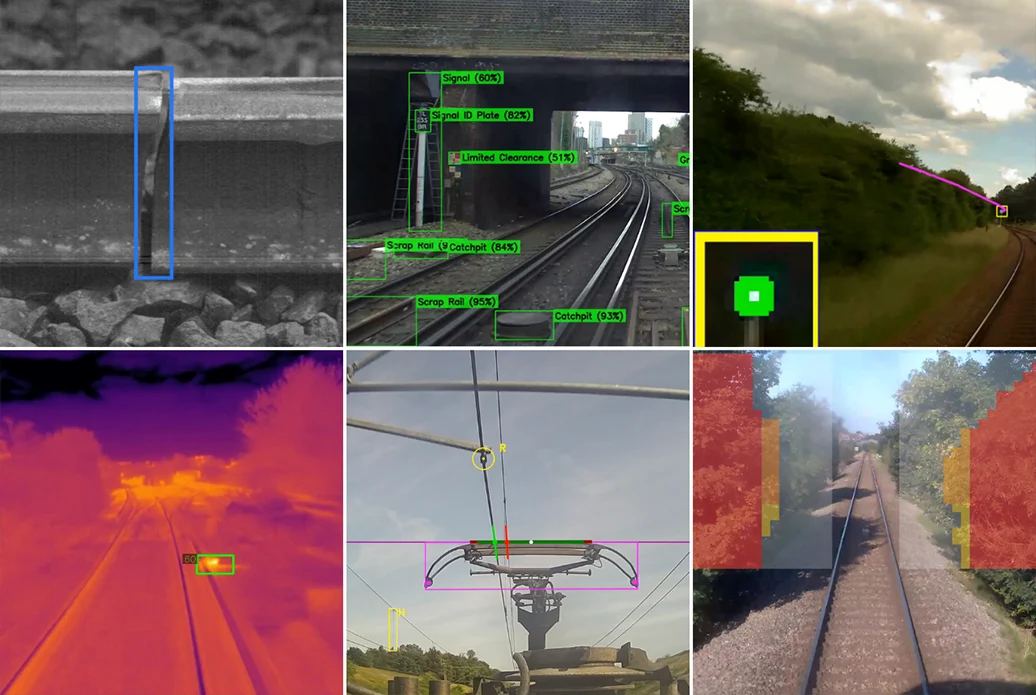
AIVR’s machine learning models cover the rail environment, mapping assets, detecting critical defects, and more, with the aim of increasing safety.
Why it matters
AI can scale expertise, reduce costs and uncover patterns in complex data that humans would miss.
The applications range across many industries. For rail, AI-powered systems such as AIVR enable more frequent, less intrusive monitoring, support predictive maintenance and improve safety by detecting deteriorating assets earlier than traditional inspection regimes.
When: key dates
The idea of ‘thinking machines’ emerged in the mid-20th century, notably with Alan Turing’s 1950 paper Computing Machinery and Intelligence, which proposed the Turing Test, a way of judging whether a machine shows human‑like intelligence by seeing if a person can tell it apart from a human in conversation.
The term ‘artificial intelligence’ was formally coined in 1956 for the Dartmouth Summer Research Project in New Hampshire, USA, widely regarded as the birth of AI as a research field. Since then, AI has evolved in waves, with machine learning and deep learning developing from the 1990s onward.
How it works: AI in railways
In rail infrastructure monitoring, AI ingests data from sensors, including video and positional instruments mounted on in-service trains or dedicated inspection vehicles. They use this to infer track geometry and condition.
Machine learning models learn the relationship between images and defects such as alignment faults, rail profile irregularities and component damage. By continuously forecasting future geometry values and mapping anomalies to precise locations, these systems support predictive maintenance planning, enabling infrastructure managers to intervene earlier while minimising disruption to normal operations.