Rapid Iteration
What is it
Rapid iteration in product development is a cyclical process of designing, testing, analysing and refining a product or feature based on evidence from real users and real-world performance.
Rather than pursuing a single ‘big bang’ release, teams develop an initial version, learn from how it behaves, then loop through successive versions that progressively improve value, usability and reliability. Rapid iteration by definition works at pace but follows a quality process to test new iterations and ensure they achieve performance improvements.
In rail infrastructure monitoring, this might mean releasing an early forward-facing video analytics tool on a limited fleet, then repeatedly tuning defect detection models, user workflows and data visualisation as engineers improve its performance until it becomes ready for the market.
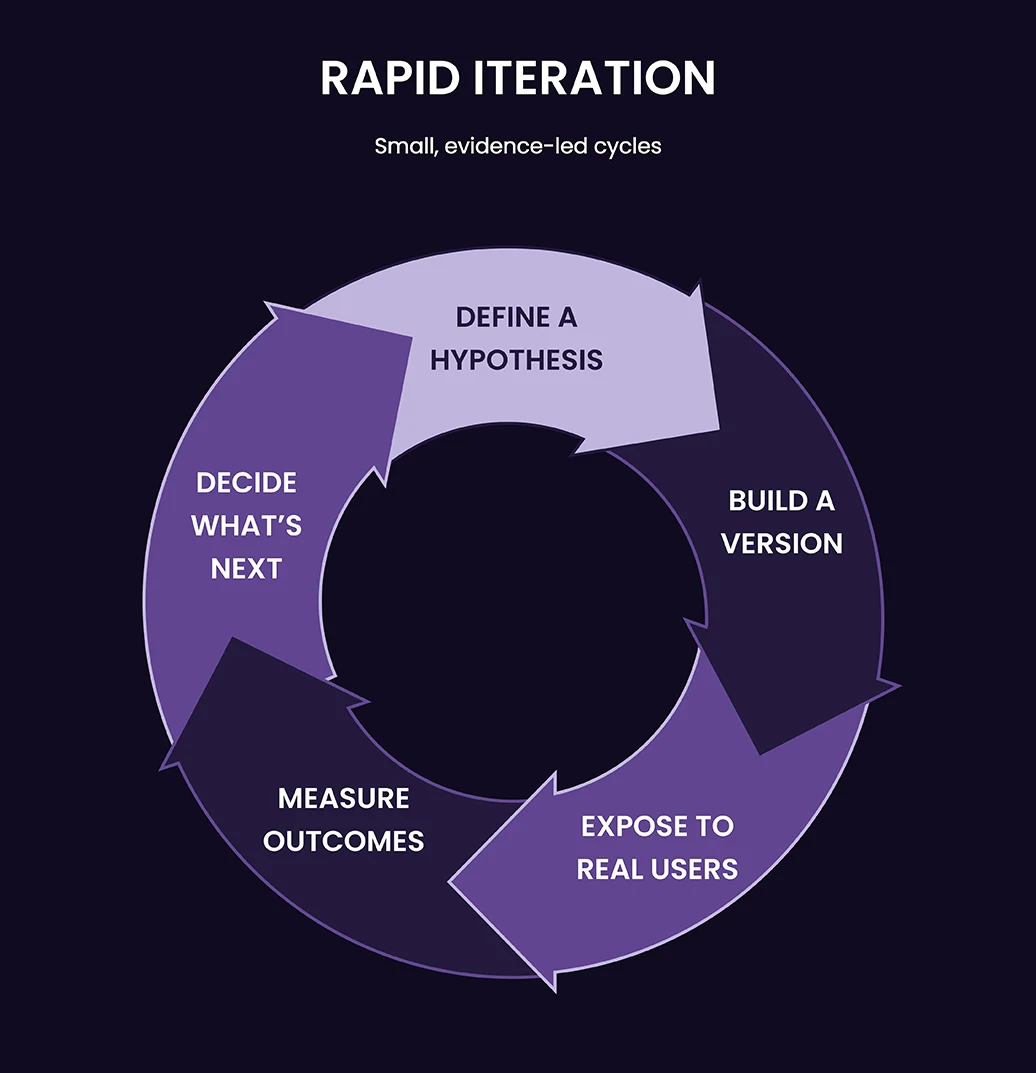
Rapid iteration as a continuous loop: define a hypothesis, build a version, expose it to real users, measure outcomes, then decide what’s next.
Why it matters
Iteration matters because innovation rarely emerges fully formed; it is usually the product of many small, informed adjustments. Continuous cycles of improvement reduce risk, expose wrong assumptions early and allow organisations to align products with evolving customer needs and operational realities. In safety-critical domains such as railway monitoring, iterative changes to hardware such as One Big Circle’s AIVR platform and its associated edge devices can incrementally improve defect detection rates and workflow fit without disrupting operations.
When and where
The term ‘iteration’ has Latin roots meaning ‘to repeat’. It has been adopted widely in engineering, computer science and mathematics rather than being coined by a single product guru. Iterative development as a formal idea gained prominence in software engineering from the 1980s, with Barry Boehm’s spiral model (1986) and later Agile methods in the 1990s–2000s emphasising short, learning-focused cycles.
Organisations such as IBM and Microsoft popularised iterative and incremental development, which then spread into manufacturing, services and rail technology suppliers building monitoring platforms. Today, firms such as One Big Circle apply iterative practices in Bristol and across the UK rail network, refining AIVR video analytics, interfaces and deployment models in partnership with operators and Network Rail.
How it works
In practice, iteration follows a simple loop: define a hypothesis, build a version, expose it to users, measure outcomes, then decide what to change next. Teams might run short, timeboxed cycles, each delivering small but testable increments, guided by metrics such as defect detection accuracy, inspection time saved or user task completion.
Across industry, that loop powers everything from consumer apps to industrial equipment; in rail infrastructure monitoring, iterative updates to algorithms that classify vegetation, level crossings or OLE condition on AIVR video can steadily lift performance and trust in remote inspection. Over time, these increments turn a basic concept into a robust, field-proven system integrated deeply into operational decision-making.