UTUs (Ultrasonic Test Units)
What are they
Ultrasonic Test Units (UTUs) are specialist Network Rail trains that use non-destructive ultrasonic testing to identify internal rail defects across the mainline network.
As part of the wider Yellow Fleet of measurement and inspection vehicles, UTUs focus on plain line defect detection rather than full-track geometry. They are typically converted coaches or multiple units equipped with advanced inspection technology, processing systems and technician workstations. Network Rail’s small fleet inspects tens of thousands of track miles annually.
Why they matter
UTUs’ main role is to find rail defects before they worsen, reducing derailment risk and allowing for planned rather than reactive maintenance. This aligns with Network Rail’s inspection standards, with frequencies set by line speed and traffic.
Strengths include:
- The system can identify visible faults on the rail head, but also invisible defects inside the rail – helpful additional information to support manual visual inspections. (See How They Works below for example.)
- High annual coverage: around 64,000 track miles with four trains over 750 shifts.
- Detects defects earlier, enhancing safety and reducing disruptive emergency repairs.
Constraints include:
- Limited access – mainly night or off-peak, running at up to around 30 mph (newer kit aims for 45 mph).
- Some defect types/orientations are challenging; manual checks remain necessary.
When: key dates
Train-borne ultrasonic inspection began in the 1960s and 70s. The current Network Rail fleet, including UTU1 (introduced in 2012), follows cyclic schedules based on risk: higher-category and high-tonnage routes get more frequent inspection. Most runs are at night or in engineering windows, but newer systems enable more daytime and higher-speed testing.
Where they are used
UTUs operate nationwide, covering main, secondary, freight and diversionary lines. Routes are prioritised using risk, traffic and defect history, with higher-use corridors seeing more frequent tests.
How they work
UTUs carry arrays of ultrasonic probes, often in a dedicated trolley or wheelset.
Many also feature ground-penetrating radar, rail profile lasers and precise positioning. Data is processed onboard, logged by technicians, then uploaded to Network Rail’s systems for maintenance planning.
US firm Sperry Rail Service provides the UTU-based ultrasonic testing and associated sensing capability. Data from the UTU fleets is also made available to rail professionals via infrastructure monitoring platform AIVR; Sperry creates suspect rail defect reports from UTU data and shares them with One Big Circle, which links imagery and posts results on AIVR for inspection.
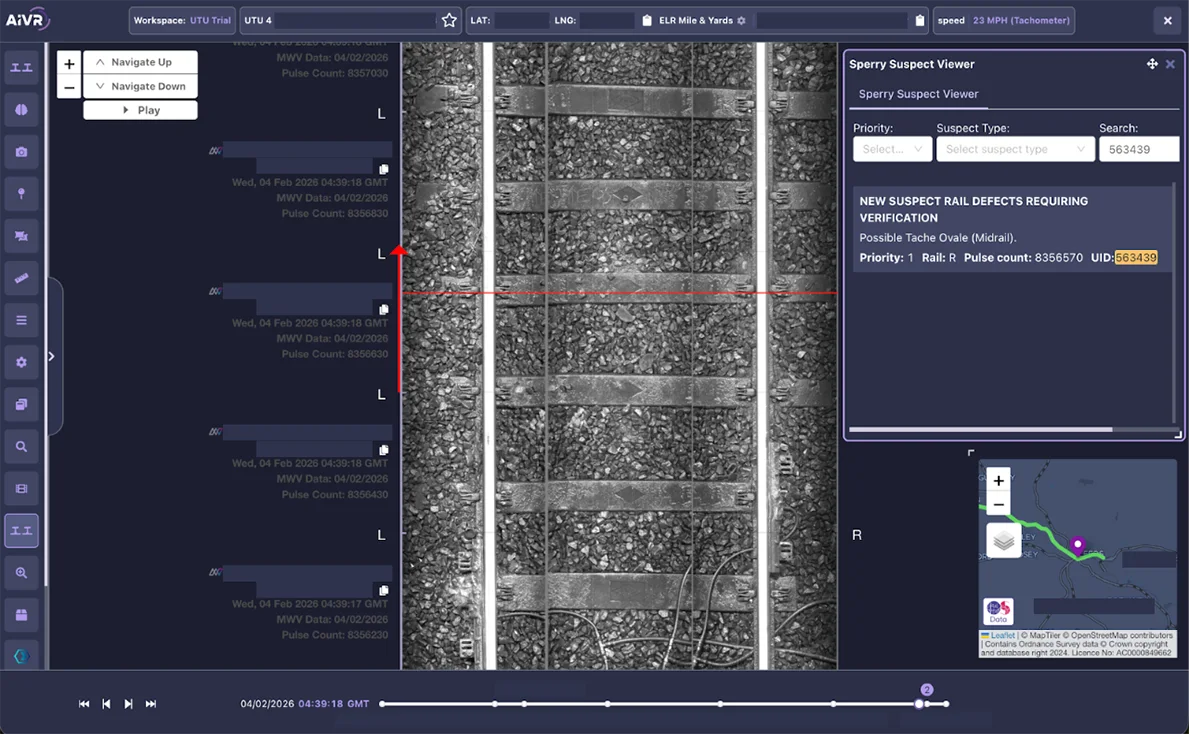
The AIVR Platform displays video and ultrasonic test data from the UTU, highlighting a suspected fault with a red line.
The above image from the AIVR identifies a suspected Tache ovale (‘oval spot’, an internal fatigue crack, typically 10-15 mm below the rail head surface, originating from manufacturing flaws like hydrogen inclusions). Appearing as a kidney-shaped spot, this transverse crack grows under service loads and can cause sudden rail fractures.