GNSS (and GPS)
What is it
A Global Navigation Satellite System (GNSS) is the umbrella term for all satellite constellations that provide global positioning, navigation and timing (PNT) services, including GPS (USA), GLONASS (Russia), Galileo (EU) and BeiDou (China).
GPS (Global Positioning System) is one specific GNSS operated by the United States, originally developed for military use but now providing civilian positioning worldwide.
In railway infrastructure monitoring, multi-constellation GNSS receivers combine signals from several systems to improve availability and accuracy along complex rail corridors.
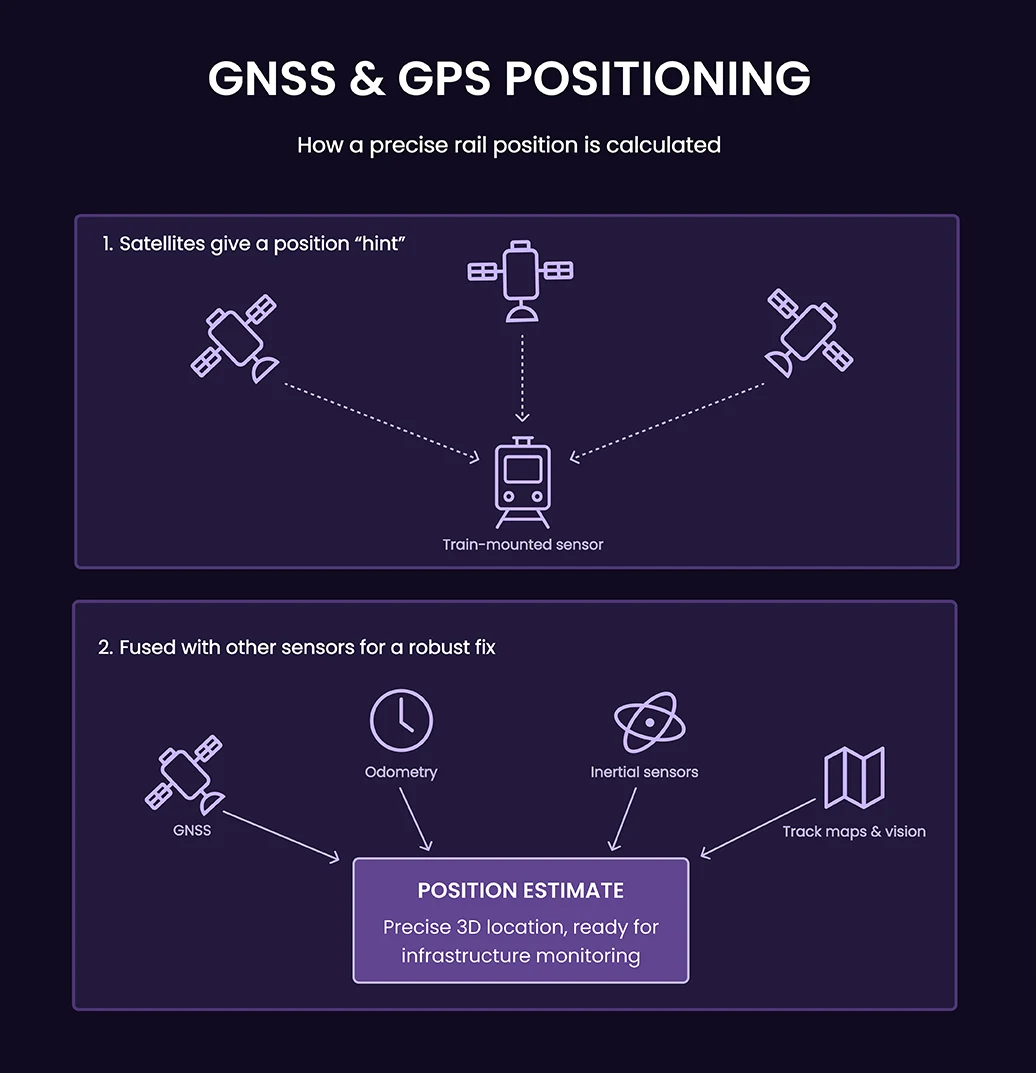
How a precise rail position is calculated: satellites give an initial fix by trilateration, which is then fused with odometry, inertial sensors and track maps for a robust, rail-grade position estimate.
Why it matters
GNSS/GPS enables real-time train tracking, speed measurement and timing, all vital for efficient railway management and operations.
It supports systems such as ETCS and CBTC (Communications‑Based Train Control, the radio‑based signalling and train control system) by providing position inputs. This can reduce reliance on trackside detection and enable increases in track capacity.
In rail infrastructure monitoring, GNSS is one of the systems used to synchronise sensor data and position. For example, AIVR uses GNSS signals as a ‘hint’ in positioning, combining with other positioning systems such as odometry for improved accuracy. Engineers can then review and interrogate this positioned data via the AIVR Platform, as demonstrated in our work with Network Rail.
When: key dates
- 1978: First GPS test satellite (Block I) launched by the US Department of Defense.
- 1993-1995: Initial operational capability for GPS as a full constellation providing global coverage.
- 2000: Selective Availability switched off, significantly improving civilian GPS accuracy.
- 2005: First experimental Galileo satellite (GIOVE-A) launched, initiating Europe’s GNSS.
- 2011 onwards: Multi-constellation GNSS receivers for rail and other safety-of-life applications become a research and deployment focus.
- Mid-2020s: Dedicated GNSS-based safety and monitoring services for rail (e.g. European GNSS Navigation Safety Service for Rail or EGNSS-R) to mature into operational demonstrations.
Who
GPS was conceived and developed by the US Department of Defense, drawing on earlier satellite navigation work by engineers in programs such as TRANSIT and Timation, and later formalised under the NAVSTAR GPS programme. Galileo was initiated by the European Union and the European Space Agency, with multinational industrial teams building and operating the system.
In railways, organisations such as the European Space Agency (ESA), the EU Agency for the Space Programme (EUSPA), rail signalling suppliers and research groups have led the adaptation of GNSS for safety-critical train control and monitoring services.
How it works
GNSS satellites broadcast precisely timed radio signals that encode their orbital position and transmission time. A receiver on a train-mounted system, such as the AIVR Forward Facing Video, or on any fixed asset measures the travel time from multiple satellites, converts this to distances and solves its own three-dimensional position and clock offset by trilateration.
Rail-grade receivers fuse these measurements with odometry, inertial sensors and track maps and Computer Vision systems such Machines With Vision’s Rail Loc, which ‘fingerprints’ ballast patterns in the four-foot and to help identify precise locations. Together these systems delivering a robust position estimate suitable for signalling and infrastructure monitoring applications.