Slab Track Systems
What is it
Slab track, or ballastless track, is a form of railway superstructure in which rails and sleepers (or rail fixation units) are supported by a rigid concrete or asphalt slab instead of a granular ballast bed. The rail is usually fastened via resilient pads and anchors to either discrete sleepers embedded in the slab (e.g. Rheda, Bögl, ÖBB/Porr) or directly to the slab in embedded-rail systems. The slab sits on a well-prepared formation or structural base (tunnel invert, viaduct deck, bridge), often with intermediate layers for drainage and vibration control.
Why it matters
Key benefits include:
- Very stable geometry with low settlement, supporting high-speed and heavy-haul loading with minimal routine tamping or lining.
- Long design lives (typically 40 to 60 years or more) and reduced routine maintenance, which can yield lower whole-life cost despite higher initial capital cost.
- Good design flexibility for noise and vibration mitigation (e.g. low-vibration track, mass-spring slabs) and cleaner track environment in stations and tunnels.
- High track fixity and a shallow profile compared to ballasted track. This makes slab track a good candidate for passing through tight structures like tunnels, or where a shallow profile is required, e.g. to pass over shallow-depth utilities.
Drawbacks and constraints include:
- High construction cost and demanding tolerances (of order ±1 mm in some systems), requiring very accurate installation and a stable substructure.
- Difficult and expensive geometry correction once concreted, longer and costlier repairs if the slab is damaged, and potentially higher noise without appropriate resilient elements.
- Stiffness transitions at the boundary between slab and ballasted track need careful design to avoid differential settlement and dynamic issues.
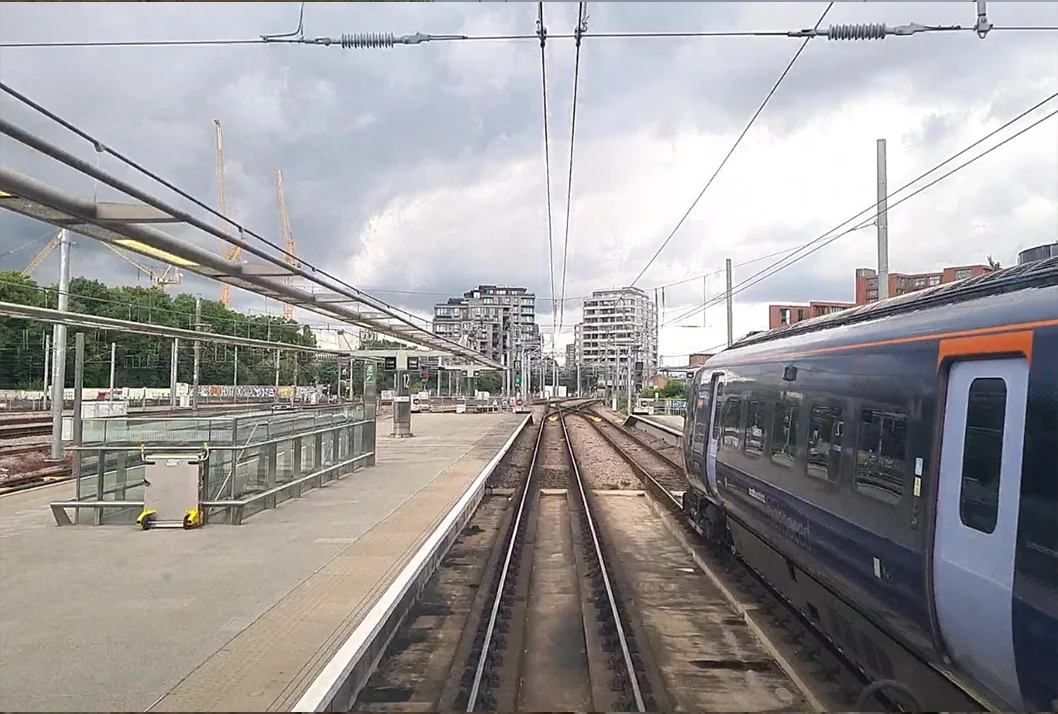
Slab track (in the foreground) transitions to ballasted track (background) at this London station, captured by AIVR.
Where it is used
Countries with extensive slab track on high-speed lines include:
- China, which has constructed around 29,000 km of ballast-less high-speed track, representing the majority of slab track worldwide.
- Japan, where Shinkansen high-speed lines now use slab track on almost all route length, particularly on viaducts and in tunnels.
- Germany, Spain and others, which use slab track widely on modern high-speed corridors and in long tunnels.
In the UK, slab track is used on High Speed 1, Crossrail/Elizabeth line central tunnels (including low-vibration “STS” trackform), London Underground, many modern tramways, and is specified for large parts of HS2 (principally high-speed and tunnelled sections).
Slab track is particularly suited to:
- Tunnels, viaducts, underground stations and constrained urban corridors where track fixity, low maintenance access, and controlled vibration are critical.
- High-speed lines, intensively used commuter corridors, and sections with poor subgrade where settlement of ballast would otherwise be problematic.
When: key dates
The first recorded slab track was a concrete slab installed under existing track by Southern Railway in the USA in 1899 to stabilise poor ground. Modern slab track for full-service railways was developed from the mid-1960s in Europe and Japan, notably in long tunnels and on the Sanyo Shinkansen opened in the early 1970s.
Use has expanded markedly over the last 30 years, driven by high-speed rail, heavier axle loads, capacity growth and pressure to reduce maintenance possessions. Global high-speed and metro programmes in China, Japan and Europe mean slab track’s route-kilometres and market share are still growing.
How it works
Structurally, slab track replaces the ballast’s flexibility with a layered system of resilient pads, booted sleepers or elastomeric elements between rail, sleeper and slab, providing the necessary vertical and lateral elasticity. Loads are transferred from rail to fastening to sleeper or support block, then into the concrete slab and finally into the formation or structure, with continuous support reducing differential settlement.
Slab track installation requires experienced teams. Typically, construction involves precision surveying, installation of reinforcement and formwork, placement and alignment of sleepers or rail-holding units and casting or placing concrete panels to tight geometry tolerances. Once cured and stressed, the track behaves as an integrated system with very stable geometry, but with adjustment limited mainly to rail grinding and small-scale fastening changes rather than large realignments.