24/11/2026
Network Rail’s Track Renewals Optimised Through AIVR

Utilising AIVR (Automated Intelligent Video Review), Network Rail’s National Track Investigation and Design Team has transformed the way in which they perform site walkovers for track renewals. Trackbed Engineer, Ade Stevenson, explains the improvements in safety, project time and costs that have been made.
The Challenges of Site Walkovers
Site walkovers are an essential part of performing track renewals. They consist of assessing a site to review all of the location’s assets and risks, to ensure that the renewal can go ahead with full awareness of any obstacles that might hinder work. For the safety of those who will work boots-on-ballast, ensuring that every detail of a site is covered in a walkover is paramount. Ade Stevenson works as a Trackbed Engineer at Network Rail, and from experience he stresses that the Track Investigation and Design Team “needs to know everything from A to B on a certain amount of track”. This can include the likes of wet beds, ballast attrition, limited clearances and UTXs (Under Track Crossings). The scope of the walkover is then handed over to their contractor, who then performs the site investigation with boots-on-ballast.
Historically, Network Rail would use raw video footage for remote walkovers, but without integrated analysis tools, utilising this footage was time-consuming at best. With the footage being stored on external hard drives, administrative work was required to lease the drives before analysis could even begin. The footage would then need to be manually checked and reported on using external tools, relying upon a keen eye to ensure that the correct site boundaries and all assets were accurately noted. Ade notes that UTXs constitute some of the most difficult assets to detect during a site walkover, and that the price for missing any of these is high:
“If two or three of these were being put in and we didn’t know about it, our contractor then wouldn’t know about it for their investigation. They need to budget how much work will be involved, and if they don’t know, they may need to book another shift, with each shift costing an average of £10,000. UTXs in particular pop up all over the place, and we need to know where they are for the excavation clearances.”
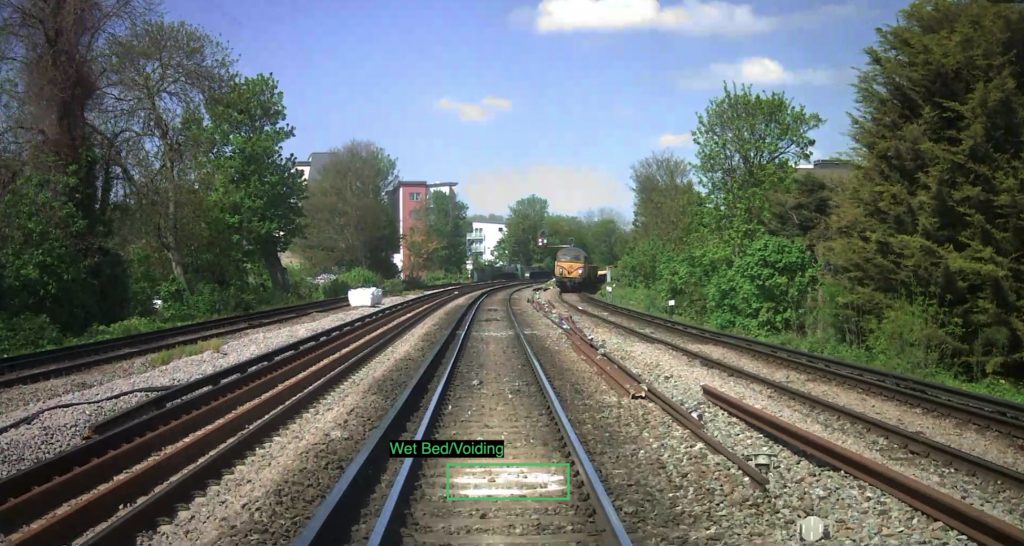
A wet bed as detected by AIVR – the Network Rail Track Investigation and Design Team must stay alert for a number of such issues in the trackbed.
The Solution – Virtual Walkovers With AIVR
Ade was among the first in Network Rail to adopt the AIVR Platform several years ago, and the platform’s features have significantly improved his team’s workflow for producing site walkover reports. “Everything’s live, everything’s streamed”, he explains, referring not only to how easily accessible AIVR’s online data is compared to the physical hard drives, but also to how regularly the AIVR Platform is updated with accurate site recordings – “We use AIVR to give [our contractor] the best information that we can, the latest and most accurate information”. Ade also appreciates the variety of imagery available to him, both in terms of the perspectives provided by different camera placements on AIVR-equipped trains, as well as the historical recordings available on all routes. These help to provide his team with the clearest view of a site – for example, a walkover can be supplemented with imagery from a different season, when obstructive vegetation is thinner.
Mileposts on the line are used to define the boundaries of a site for investigation, and with distances being kept in sync with footage on the AIVR Platform, keeping track of these boundaries is made straightforward. Prior to their walkover, Ade’s team will be given a Particular Specification that provides these site boundaries, which can then be easily entered into the platform and marked. “AIVR is good because it’s accurate and gets you to the nearest yard possible”, Ade states, “to the milepost that we’ve been specified to use”. Ade’s team then uses AIVR’s automated detections alongside their own annotations to ensure that their walkover reports are as accurate and comprehensive as possible – “The more accurate we are, the less questions we get. AIVR provides the latest data for this”.
The final step of the team’s work is compiling the report to be provided to the contractor. With the AIVR Platform’s MP4 and PDF report export options, Ade’s team are able to instantly produce reports that contain all of their detections and annotations, keeping the contractor fully informed. “The good thing about AIVR is that it populates its own report”, says Ade, explaining that previously, “we’d have to take screenshots and add them into a Word document, and then we’d need to try to shrink the huge file size.” The administrative steps following analysis are kept simple on the AIVR Platform, so as to keep the focus on the data that matters for the investigation.
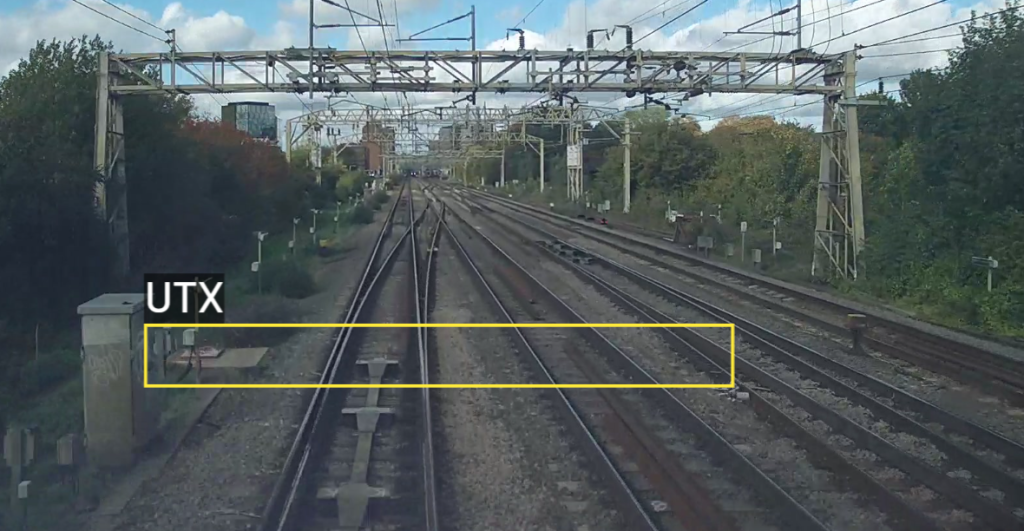
Ade’s team must be aware of Under Track Crossings (UTXs) within a worksite’s vicinity, but these can be elusive. AIVR aids in the identification of UTXs to prevent costly repeated callouts.
A Safe and Optimal Workflow
Ade and his team have pushed to streamline track investigation processes as much as possible, with the aim to “keep boots off the ballast and eyes on the track” – improving safety whilst emphasising accuracy of information. With the team’s site walkovers now taking place through the AIVR Platform, the time, cost and risks of performing in-person walkovers have been mitigated, and the tools offered through the platform allow the team to confidently provide evidence to their contractor that all of the risks of a track renewal project have been accounted for. The AIVR Platform provides Ade and his team with a way to not only easily access the sites they need to review, but also all of the data that they need to produce reports with the high accuracy that they aim for.
“My kingdom for a milepost! If I can see a milepost, I’m happy.”
A very special thanks to Ade Stevenson for agreeing to take part in this case study.