Rail Profile
What is it
Rail profile is the cross-sectional shape of the rail. The profile is usually described in terms of its head, web/waist and foot, plus functional surfaces such as the gauge face and running band. Each of these features matters for how loads are carried, how wheels steer and wear, and how condition is monitored over time.
Basic rail anatomy terms
Head
The head is the top part of the rail that the wheel tread and wheel flange contact, often carrying around 30 to 40% of the total steel in modern profiles. It must resist wear, rolling contact fatigue and plastic flow (permanent deformation).
Monitoring head-height loss and head-shape changes is central to rail asset management.
Web
The web is the vertical section connecting head and foot, acting mainly in shear and bending. Excessive thinning, cracking at the web-head or web-foot fillets, or corrosion on the web are key indicators for renewal or repair decisions.
Foot/base
The foot (or “base” in the USA) spreads loads into sleepers or slab and provides the bearing surface for fastenings. Foot condition affects track stability, fastener performance and risk of cracking or other defects, so monitoring includes checking foot width, damage and corrosion, especially in wet or contaminated environments.
Key functional surfaces
Gauge face and gauge corner
The gauge face (also known as ‘inside face’ or ‘running edge’) is the face of the rail head on the traffic side; the curved transition is the gauge corner. Side wear at the gauge face (often called sidewear or gauge-corner wear) is critical in curves because it affects gauge and flange contact and may contribute to noise and derailment risk.
Field face
The field face is the outside face of the rail head – the side that faces away from the track gauge and towards the cess or adjacent track.
Crown and Running Band
The running band is the zone on the rail head where the wheel tread predominantly contacts; the crown is the highest part of the head. Monitoring the position and width of the running band supports wheel-rail contact optimisation, grinding strategies and control of equivalent conicity for ride stability.
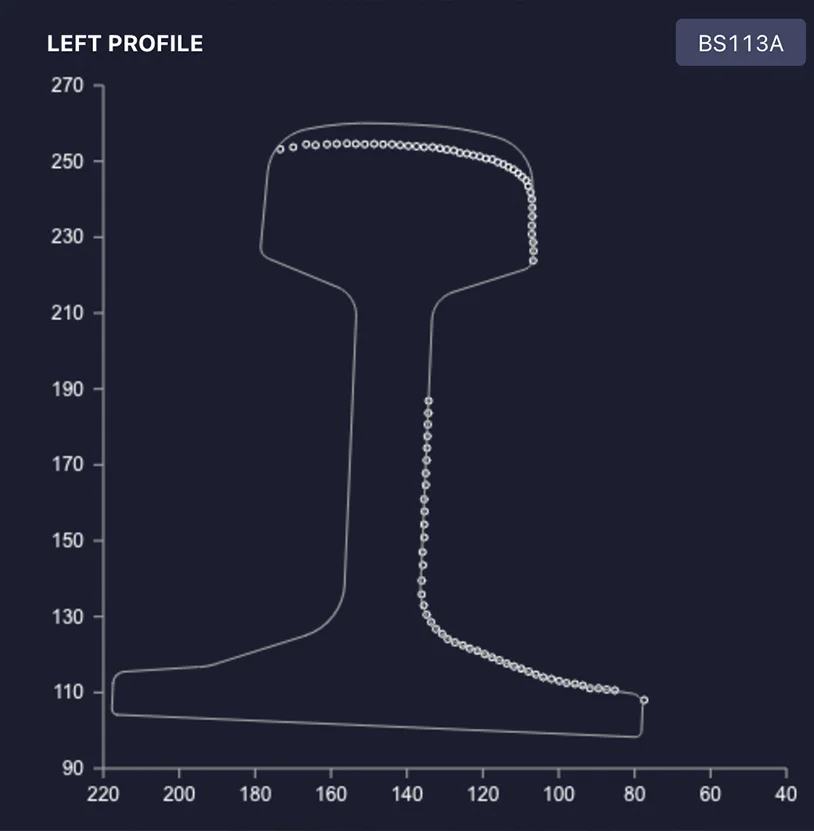
AGS (AIVR Geometry System) captures precise rail profile measurements using laser technology.
International terminology and monitoring relevance
UK practice typically uses ‘rail head’, ‘web’, ‘foot’, ‘gauge face’ and ‘running band’, while US and some other countries more often say ‘base’ for foot and ‘gauge side’ for gauge face. Rail profiles are also classified by weight per metre, , which influences allowable axle load and speed. For example, in Europe, 56E1 and 60E2 are so called because they weigh 56kg/m and 60kg/m respectively.
A number of legacy rail profiles are in use in the UK, including 95lb/yd bullhead and 100lb/yard flatbottom. FB is an acronym for flatbottom rail, and BH for bullhead rail. Flatbottom is the standard modern rail section with a wide, thin, flat ‘foot’ that sits directly on the sleeper or on a baseplate.
Modern infrastructure monitoring uses contact and non-contact systems on measurement trains and inspection vehicles to capture rail profile, compare it with reference templates, and track wear and damage over time to support condition-based maintenance and grinding, re-profiling or renewal decisions.