CASE STUDY
Network Rail
How Network Rail worked collaboratively to bring advanced video capability into the industry
Network Rail used AIVR technology to help face the challenges of monitoring and maintaining the rail network – and over five years, that partnership has grown into one of the most advanced infrastructure monitoring programmes in the country.
The Challenge
With over 20,000 miles of track to monitor and maintain, Network Rail have relied heavily upon scheduled inspections and manual site visits, whilst timetabling their Measurement Fleet on an increasingly congested mixed-use railway network.
Alongside growing demand for digitalisation, a confluence of factors created an urgent need for change: Track Worker Safety requirements, their Measurement Fleet approaching obsolescence, a changing workforce, operational pressures, and the unprecedented impact of Covid. Together, these drivers led Network Rail to explore smarter, safer methods of infrastructure inspection.
The Solution: AIVR
Early Introduction
In early 2020, One Big Circle introduced AIVR to Network Rail – automatically sending video imagery from in-service and measurement vehicles to the cloud, with secure online access for users to view up-to-date infrastructure imagery in rapid time. Whilst cameras on trains was not a new concept, the ability to view and interrogate that data had always been severely restricted, providing limited benefit to engineering teams.
Building the Right Services
OBC provided Network Rail with a comprehensive range of AIVR data capture options – including Forward-Facing, Track, Thermal, Geometry and more. Delivered through both rapidly deployable devices and permanent installations on various train types, Network Rail were able to build their optimal combination of data types and capture frequency to deliver maximum operational benefit.
Scaling with Demand
As data capture capabilities grew, Network Rail confidently extended access to an increasing number of users across the organisation, assured that AIVR could support enterprise-scale deployment. From an initial handful of stakeholders, the user base expanded to over 11,000 individuals spanning multiple disciplines. In response to user feedback, OBC built an increasing range of digital tools that enabled engineers to monitor, measure and plan remotely – reducing millions of hours of boots on ballast.
AI-Powered Intelligence
From 2022 onwards, as users gained confidence in the source and quality of AIVR data, a series of Machine Learning advancements were delivered to automate asset and condition detection. By 2025, over 100 different assets and conditions could be automatically detected and reported. Reporting mechanisms were configured to meet discipline-specific requirements, ensuring users received the information they needed, when they needed it.
Example Applications
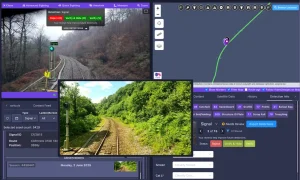
Remote Inspection
Remote assessments have reduced track access requirements, with major safety advancements realised across the network. Users now cover significantly more track in less time.
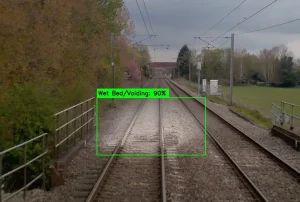
Asset Mapping & Condition
A comprehensive asset database has been built without manual surveys. Trackside assets are located and identified automatically, with asset conditions continually monitored.
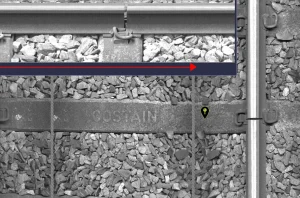
Serious Track Defects
Automated identification of critical safety issues means early detection has prevented catastrophic failures, significantly increasing safety and delivering cost efficiencies.
Key Benefits and Outputs
- Continual Delivery – 5 years of continuous contract between Network Rail and OBC, delivering service and innovation
- Full Network Coverage – 240+ AIVR systems deployed, delivering data to a unified online platform
- 100+ Machine Learning Models – deployed across multiple infrastructure disciplines for assets and conditions
- Seamless Integration – integrated with multiple data suppliers and systems for comprehensive monitoring
- 3 Million+ Hours – boots on ballast removed through remote inspection capabilities
- Dynamic Data Management – innovative capability to manage over 5PB of data efficiently
Testimonials
Benefits

Virtual Track Access

Open Data

Increases Safety

Easy to Use

Time Saving

Automated Infrastructure Monitoring

Reducing Boots on Ballast

Seasonal Planning